

Table of Contents
- What Makes Anime Streetwear Different From Standard Graphic Tees
- How to Spot Legit Anime Streetwear Brands (And Avoid Scams)
- How to Style Anime Hoodies for Everyday Wear
- Minimalist Anime Clothing: Subtle Ways to Show Your Fandom
- Officially Licensed Anime Apparel vs. Independent Artist Designs
- Fabric Weight, Print Longevity, and What Lasts
- Sizing, Shipping, and Returns: What to Check Before You Buy
- Frequently Asked Questions
Last Updated: September 22, 2026
What Makes Anime Streetwear Different From Standard Graphic Tees
Anime streetwear fuses Japanese pop culture imagery with the cuts, fabrics, and attitude of contemporary streetwear, rather than simply printing a character on a blank tee. This guide from Rose Mchale breaks down how to judge anime streetwear brands, style the pieces, and avoid the scams that plague this market.
Here's what separates the two:
- Silhouette: boxy, oversized cuts instead of a standard crew fit
- Fabric weight: heavier cotton that drapes rather than clings
- Design language: minimal anime design and graphic language woven into the garment, not slapped on
- Intent: pieces meant for daily wear, not just a convention weekend
How to Spot Legit Anime Streetwear Brands (And Avoid Scams)
- No size chart, or one that lists only S/M/L with no measurements
- Reviews that are all five stars and posted within the same week
- No physical return address or policy page
- Stock images that appear on multiple unrelated stores
Authenticity matters too. Officially licensed anime apparel carries a verifiable licensing mark or brand name, and independent designs should credit the artist. If neither is present, treat it as a red flag.
How to Style Anime Hoodies for Everyday Wear
The trick to styling anime hoodies for daily wear is treating the hoodie as the statement piece and keeping everything else quiet. The execution changes depending on which aesthetic you're building toward.
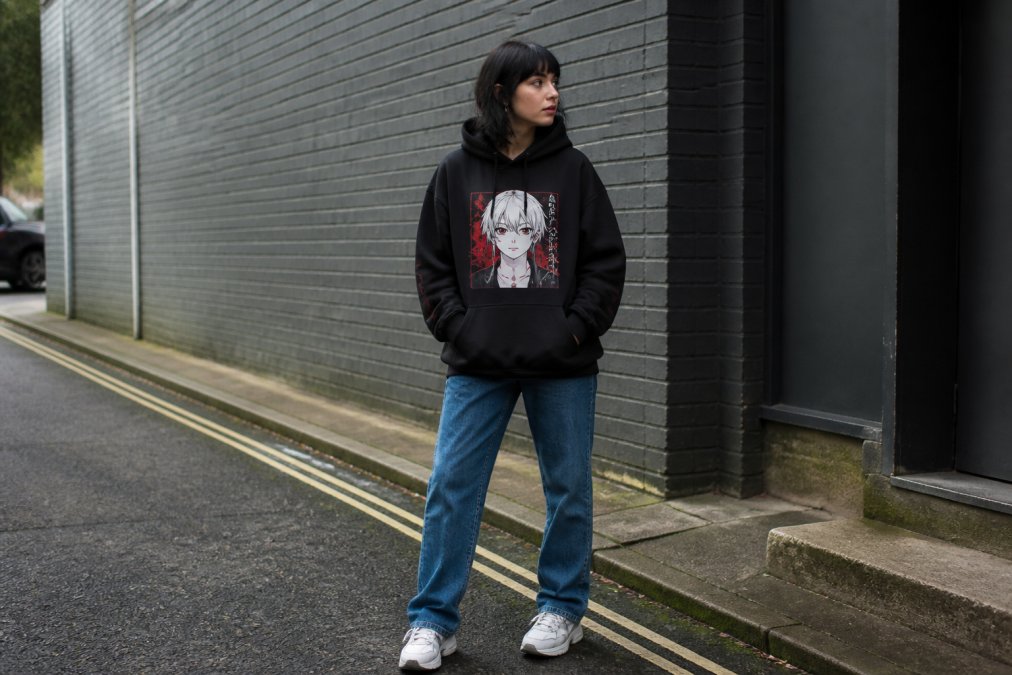
The Oversized Streetwear Look
An oversized hoodie works when the rest of the outfit is deliberate. The rule most stylists use: if the hoodie is two sizes up, the pants should be one size down. Pair a boxy hoodie with tapered jeans or joggers so proportions balance instead of stacking bulk on bulk.
- Hoodie: boxy, drop-shoulder, 400+ GSM French terry
- Bottoms: tapered denim or cuffed joggers
- Shoes: clean low-profile sneakers in white, black, or cream
- Accessories: one beanie or cap, nothing more
The Techwear Crossover
Techwear and anime graphics overlap more than people expect, both lean on dark palettes, utility straps, and asymmetric cuts. A minimalist anime hoodie in black or charcoal slots into a techwear fit without looking like cosplay.
- Hoodie: tonal or single-color graphic, no full-back print
- Bottoms: cargo pants with visible pockets and adjustable hems
- Shoes: chunky tactical sneakers or combat boots
- Layer: a shell jacket or utility vest over the hoodie
The Minimalist Everyday Fit
For school, work, or anywhere you don't want to announce your fandom, build around a small-motif hoodie and neutral basics.
- Hoodie: small chest embroidery or tonal print
- Bottoms: straight-leg chinos, dark denim, or tailored joggers
- Shoes: minimal leather sneakers or loafers
- Layer: an overshirt or bomber over the hoodie
The Layered Statement Fit
To make the hoodie the loudest thing in the room, layer it under an open jacket so the graphic peeks through rather than dominating.
- Hoodie: full-back or all-over print
- Jacket: open, unzipped, contrasting color
- Bottoms: solid black or dark indigo
- Shoes: statement sneakers that echo one color from the graphic
Proportion Rules That Apply to Every Fit
Regardless of aesthetic, three rules hold:
- One loud piece per outfit. Two prints fight each other and the look tips from fashion-forward into costume.
- Balance volume with structure. Oversized top means fitted or tapered bottom. Fitted top means you can go wider on the bottom.
- Match formality across the fit. A heavyweight hoodie with dress trousers looks confused. A lightweight hoodie with heavy boots looks the same way.
If you're building a capsule wardrobe around fandom, start with two or three minimalist pieces and one louder statement hoodie. The quiet pieces get worn far more often.
Minimalist Anime Clothing: Subtle Ways to Show Your Fandom
Minimalist anime clothing uses small motifs, tonal embroidery, or single-line character art so the reference reads only to people who know it. It's fandom for people who don't want to shout.
Look for:
- Tonal prints where the artwork is the same color as the fabric
- Small chest or sleeve embroidery instead of a full-back print
- Single-line or abstract character art that hints rather than announces
- Neutral colorways in black, cream, or olive
Officially Licensed Anime Apparel vs. Independent Artist Designs
Officially licensed anime apparel is produced under a formal agreement with the rights holder, while independent artist designs are created and sold by individual creators, often in small batches. Both have a place, and each has trade-offs.
| Factor | Officially Licensed | Independent Artist |
|---|---|---|
| Art accuracy | Matches source material | Artist's interpretation |
| Uniqueness | Widely available | Limited edition drops |
| Quality control | Consistent | Varies by creator |
| Price | Often higher | Often lower |
| Verifiability | Licensing mark | Artist credit |
Fabric Weight, Print Longevity, and What Lasts
The two numbers that predict how long a piece lasts are fabric weight and print method. Heavier cotton holds its shape, and a properly applied print survives repeated washing, but "properly applied" covers three very different techniques.
Fabric Weight: What GSM Actually Means
Fabric weight is measured in grams per square meter, or GSM. It's the single most useful spec on a product page, and most brands bury it.
- 140-150 GSM: standard lightweight tee. Thin, semi-transparent in light colors, prone to stretching at the collar.
- 180-200 GSM: midweight. The sweet spot for everyday graphic tees. Holds shape, drapes cleanly, still breathable.
- 220-260 GSM: heavyweight tee. Structured, opaque, and noticeably warmer. Common in premium streetwear.
- 300-400+ GSM: French terry and fleece territory. This is where hoodies live. Below 300 GSM, a hoodie feels flimsy after a few washes.
Print Methods: DTG vs. Screen Print vs. Embroidery
Print longevity depends on how the ink or thread bonds to the fabric. Three methods dominate anime streetwear.
-
Best for: detailed, full-color artwork with gradients and fine linework, exactly what anime graphics need
-
Durability: good on 100% cotton, weaker on blends. Fades gradually rather than cracking.
-
Trade-off: the print sits in the fabric rather than on top of it, so it feels softer but looks less saturated than screen print
-
Cost signal: low setup cost, which is why small independent artists use it for limited drops
-
Best for: bold, high-contrast designs with a limited color count
-
Durability: the most durable option when done correctly. The ink sits on top of the fabric and can outlast the garment.
-
Trade-off: each additional color adds a screen and a cost. Complex anime art with 12 colors becomes expensive fast.
-
Cost signal: high setup cost, which is why screen printing shows up on larger runs and licensed drops
Embroidery stitches thread directly into the fabric.
- Best for: small logos, chest marks, sleeve details, and tonal designs
- Durability: effectively permanent. Thread doesn't crack, peel, or fade the way ink does.
- Trade-off: limited detail. Fine linework and gradients don't translate well to thread.
- Cost signal: priced per stitch count, so small designs are affordable and large ones are not
What to Avoid
Heat transfers, vinyl patches pressed onto cheap blanks, are the most common failure point in this category, peeling at the edges within a handful of washes. If a product page mentions "heat press" or "vinyl transfer" without naming a print method, treat it as a warning sign.
Washing and Care: The Mechanism Behind the Damage
Prints fail for predictable reasons: heat and friction.
- Hot water causes cotton fibers to swell and contract, which stresses the ink bond.
- Tumble drying tumbles the garment against itself, abrading the print surface.
- Bleach and fabric softener break down the ink chemistry and leave residue that traps dirt in the print.
The fix is simple and applies to every print method:
- Turn the garment inside out before washing
- Wash cold on a gentle cycle
- Skip fabric softener
- Air dry, or tumble on low if you must
- Iron inside out, never directly on the print
Sizing, Shipping, and Returns: What to Check Before You Buy
Before you buy, confirm three things: a measurement-based size chart, a stated shipping timeline, and a return window you can live with. Missing any one of them is a reason to buy elsewhere.
Check for:
- A size chart with actual measurements in inches or centimeters, not just S/M/L labels
- Fit notes that say whether a piece runs oversized, true to size, or small
- Model measurements so you can compare against your own
Before you check out anywhere, do this:
- Confirm the size chart has real measurements
- Read the shipping timeline, not just the shipping cost
- Check the return window and who pays return shipping
- Look for customer reviews with photos of the actual product
Frequently Asked Questions
How do I identify authentic anime streetwear brands?
Check for official licensing logos on the product page, clear size charts, and real customer photos in reviews. Legit brands list fabric weight and care instructions. Avoid sites with no return policy, stock photos only, or prices that seem too low. Search the brand name plus 'reviews' to see if buyers report shipping delays or quality issues. Rose Mchale offers a 30-day exchange window and free U.S. shipping over $75, which gives you a safety net if something does not work out.
Are there anime streetwear brands that offer subtle, minimalist designs?
Yes. Minimalist anime clothing usually features small embroidered logos, single-color screen prints, or subtle references like a character's symbol rather than a full illustration. These pieces work for school, work, or casual hangouts because they read as regular streetwear first. Look for brands that describe their designs as 'understated' or 'clean' and show photos of the item worn in normal settings, not just convention floors.
What should I check before buying anime hoodies online?
Start with the size chart: measure a hoodie you already own and compare chest, length, and sleeve measurements. Check fabric weight (measured in GSM or oz/yd²) because heavier fabrics hold prints better and last longer. Read the return policy and shipping timeline. If the brand does not show real customer photos or specify print method (screen print vs. DTG), ask before ordering. Rose Mchale lists fabric details and offers easy exchanges if the fit is off.
How long do anime streetwear prints typically last?
Print longevity depends on the method and care. Screen-printed designs on heavyweight cotton can last years with cold washes and air drying. Direct-to-garment (DTG) prints may fade faster, especially on darker fabrics. Always wash inside out, skip the dryer, and avoid ironing directly on the print. Brands that specify fabric weight and print type give you a better idea of what to expect. Check customer reviews for photos after months of wear.
The hardest part of buying anime streetwear isn't finding designs you like. It's finding a store you can trust to fit right, ship on time, and take the piece back if it doesn't work out. Rose Mchale carries a curated selection of anime-inspired hoodies, crop tops, and bodysuits built for everyday wear, with free standard shipping on U.S. orders over $75, easy 30-day exchanges, and hassle-free returns. Get started with Rose Mchale and wear your fandom with confidence.