

Best overall: Yuji Itadori’s school uniform. Best for a prop-free build: Satoru Gojo. Best wardrobe-based option: Kento Nanami. This 2026 guide ranks the best Jujutsu Kaisen cosplay costumes by character accuracy, fitting demands, accessories, and how you plan to wear them.
- Yuji Itadori tops the best Jujutsu Kaisen cosplay costumes for a distinctive uniform without a large signature prop.
- Satoru Gojo suits fans who want a prop-free costume, but eye coverings must not compromise visibility.
- Kento Nanami is the wardrobe-based pick; the suit, shirt, tie, and glasses need coordinated reference checking.
- Compare measurements and included components before choosing any anime cosplay costume set.
WHY THIS MATTERS
A recognizable character design and a well-made costume are different things. A listing can show the right silhouette while leaving you to resolve fit, missing accessories, or a collar that will not hold its shape.
Rosemchale sells anime cosplay costumes and streetwear apparel. This Jujutsu Kaisen guide compares character builds—not named retail sets—so you can choose your look before evaluating a seller’s construction and sizing.
Rosemchale’s Jujutsu Kaisen cosplay guide is best for fans choosing a character build before comparing individual listings. The recommendations below separate each character’s visual strengths from the practical compromises you need to check.
WHAT MAKES THE BEST JUJUTSU KAISEN COSPLAY COSTUMES?
Use these criteria for your 2026 shortlist. Character popularity does not answer whether a costume fits your body or your event.
- Reference accuracy: Match a specific version of the character. Compare the collar, closures, proportions, colors, and accessories against that reference.
- Measured fit: Look for usable garment measurements, not just a familiar size letter. Shoulders, chest, waist, sleeves, and length need separate attention.
- Construction: Inspect seams, closures, lining information, and fabric descriptions. A polished promotional image does not show how a garment behaves when you sit.
- Component clarity: Check exactly which pieces belong to the selected option. A photographed wig, shoe, or prop is not proof that it is included.
- Wearability: Consider visibility, walking, sitting, bathroom access, and carrying your belongings. Your costume needs to work beyond a single photograph.
- Finishing workload: Decide whether you want to style a wig, alter trousers, shape a collar, or build a prop. Choose the project you actually want to finish.
THE CHARACTER BUILDS AT A GLANCE
| Rank and costume | Best for | Standout design feature | Key limitation |
|---|---|---|---|
| 1. Yuji Itadori’s school uniform | First character-focused build | Red hood against a dark uniform | Hood shape and jacket proportions need attention |
| 2. Satoru Gojo’s dark uniform | Prop-free cosplay | High collar, white hair, and eye covering | Eye coverings introduce visibility concerns |
| 3. Megumi Fushiguro’s school uniform | Fans who enjoy wig styling | Angular dark hairstyle and high collar | The wig carries much of the character identity |
| 4. Nobara Kugisaki’s school uniform | Skirt-based action styling | Coordinated jacket, skirt, belt, and hammer | Prop handling and skirt movement need rehearsal |
| 5. Kento Nanami’s suit | Wardrobe-based assembly | Light suit with shirt, patterned tie, and glasses | Ordinary tailoring makes proportion errors noticeable |
1. YUJI ITADORI: BEST COSPLAY FOR A FIRST CHARACTER BUILD
Yuji Itadori’s school uniform pairs a dark jacket and trousers with a red hood. The color contrast gives you a clear reference point when comparing costume photos, and the core uniform does not depend on carrying a large signature weapon.
Best for: Fans who want a distinct anime uniform with a manageable accessory checklist. For an undecided first-time cosplayer, Yuji is the default recommendation in this 2026 ranking.
YUJI ITADORI PROS
- The red hood gives the outfit a specific visual anchor.
- The jacket-and-trouser structure keeps the main outfit easy to organize.
- The core look leaves your hands free without a large prop.
YUJI ITADORI CONS
- An incorrectly shaped hood changes the upper-body silhouette.
- A boxy jacket can hide the proportions shown in your reference.
- Hair styling and footwear still need attention; the uniform alone does not finish the character.
Check whether the hood is attached, separate, or simply suggested by the product photography. Inspect the jacket while open and closed if the listing provides those views. For trousers, compare the hem position with the footwear you intend to wear rather than judging length in isolation.
Do not add details from another Yuji appearance just because they look dramatic. Choose the version first, then keep the outfit consistent.
Verdict: Buy a Yuji-style uniform if you want the strongest default starting point; skip sets with unclear hood construction.
2. SATORU GOJO: BEST COSPLAY FOR A PROP-FREE LOOK
Satoru Gojo’s dark high-collared uniform, white hair, and eye covering create a sharply defined character silhouette. Choose a specific blindfold or sunglasses reference before assembling the outfit; those are different styling decisions, not interchangeable finishing touches.
Best for: Fans who want character-focused portraits without managing a handheld weapon. Gojo rewards attention to the collar, wig, and face framing more than a crowded accessory list.
SATORU GOJO PROS
- The core uniform does not require a large handheld prop.
- The high collar creates a clear upper-body shape.
- A consistent wig and eye-covering choice gives the build a focused direction.
SATORU GOJO CONS
- A blindfold can obstruct your view and is unsuitable for walking when you cannot see clearly.
- A collapsing collar weakens the intended silhouette.
- A white wig needs deliberate shaping rather than a straight-from-the-bag approach.
Ask how the collar holds its shape and check the neck opening against your measurements. A dramatic product pose can conceal a collar that presses against your jaw when you turn your head.
For event movement, prioritize unobstructed vision. Remove an obstructive covering before walking, and use the covered-eye version only for stationary photographs with assistance.
Verdict: Buy the Gojo build for a prop-free costume; skip wearing an obstructive eye covering while moving.
3. MEGUMI FUSHIGURO: BEST COSPLAY FOR WIG STYLING
Megumi Fushiguro’s dark school uniform puts the focus on his angular hairstyle and upright collar. The clothing provides the base, but the head-and-shoulder silhouette deserves as much planning as the jacket.
Best for: Fans who enjoy shaping a character wig and keeping the outfit visually restrained. Megumi is a clear choice when the styling work is part of the appeal.
MEGUMI FUSHIGURO PROS
- The uniform keeps the clothing palette focused.
- The hairstyle gives you a specific styling target.
- Hand poses provide a character-based photography direction without requiring a large carried accessory.
MEGUMI FUSHIGURO CONS
- A generic dark wig does not reproduce the distinctive silhouette.
- Poor collar construction is conspicuous beside a carefully styled wig.
- Large styled sections need a transport plan that protects their shape.
Compare the wig from the front, side, and back before deciding it is finished. Spikes that look convincing head-on can become flat or disconnected from another angle.
Check sleeve movement while rehearsing your intended poses. If raising your arms pulls the jacket sharply upward, resolve the fit before adjusting the wig around a restrictive outfit.
Verdict: Buy the Megumi build if wig styling is part of your project; skip it if you want no hair preparation.
4. NOBARA KUGISAKI: BEST COSPLAY FOR SKIRT-BASED ACTION STYLING
Nobara Kugisaki’s uniform combines a dark jacket and skirt with a belt, while her hammer supplies a character-specific accessory. The outfit works best when the clothing proportions and prop plan are considered together.
Best for: Fans who want a skirt-based uniform and deliberate action poses. Choose the exact appearance you want to reproduce before matching the hair, skirt length, and accessories.
NOBARA KUGISAKI PROS
- The jacket, skirt, and belt create several clear reference checkpoints.
- The hammer offers an obvious focus for posed photographs.
- The outfit supports both standing portraits and rehearsed action compositions.
NOBARA KUGISAKI CONS
- Skirt fit needs checking while seated and moving, not only standing.
- Carrying a prop adds another item to manage throughout the event.
- Real tools and sharp accessories are inappropriate substitutes for event-safe props.
Read the venue’s current prop rules before choosing a hammer or any nail-shaped accessory. Use clearly nonfunctional costume pieces that comply with those rules; character accuracy does not override safety requirements.
Check that the belt stays where you want it without distorting the jacket. Rehearse reaching, sitting, and your intended stance with whatever underlayers you plan to wear.
Verdict: Buy the Nobara build for skirt-based action styling; hold the prop decision until you have checked venue rules.
5. KENTO NANAMI: BEST COSPLAY FOR WARDROBE-BASED ASSEMBLY
Kento Nanami’s familiar suit-based appearance uses a light suit, blue shirt, patterned tie, and distinctive glasses. It gives you a route built around tailoring rather than a school-uniform replica, but matching ordinary clothing still requires careful reference work.
Best for: Fans who prefer assembling separate garments and refining the fit. Choose Nanami because you like the tailoring project, not because a suit automatically makes the costume effortless.
KENTO NANAMI PROS
- The outfit can be approached as separate, clearly defined clothing pieces.
- Suit alterations offer a direct way to refine the silhouette.
- Hair, glasses, and tie provide focused finishing tasks.
KENTO NANAMI CONS
- A generic suit without the supporting details loses character specificity.
- Jacket length, trouser break, and shoulder fit all affect the final result.
- Adding Nanami’s weapon introduces transport and venue-rule checks.
Start with the shoulder fit before assessing the rest of the jacket. Then compare the shirt color, tie pattern, glasses, and hairstyle against the same reference rather than selecting each piece independently.
Verdict: Buy or assemble the Nanami build if you enjoy tailoring; skip treating any light-colored suit as a finished costume.
CHECK THE FIT BEFORE YOU COMMIT
Rosemchale’s Jujutsu Kaisen cosplay recommendations put character selection first, but your measurements decide whether an individual listing belongs on your shortlist. For your 2026 event, compare the actual garment information with clothing that already fits you well.
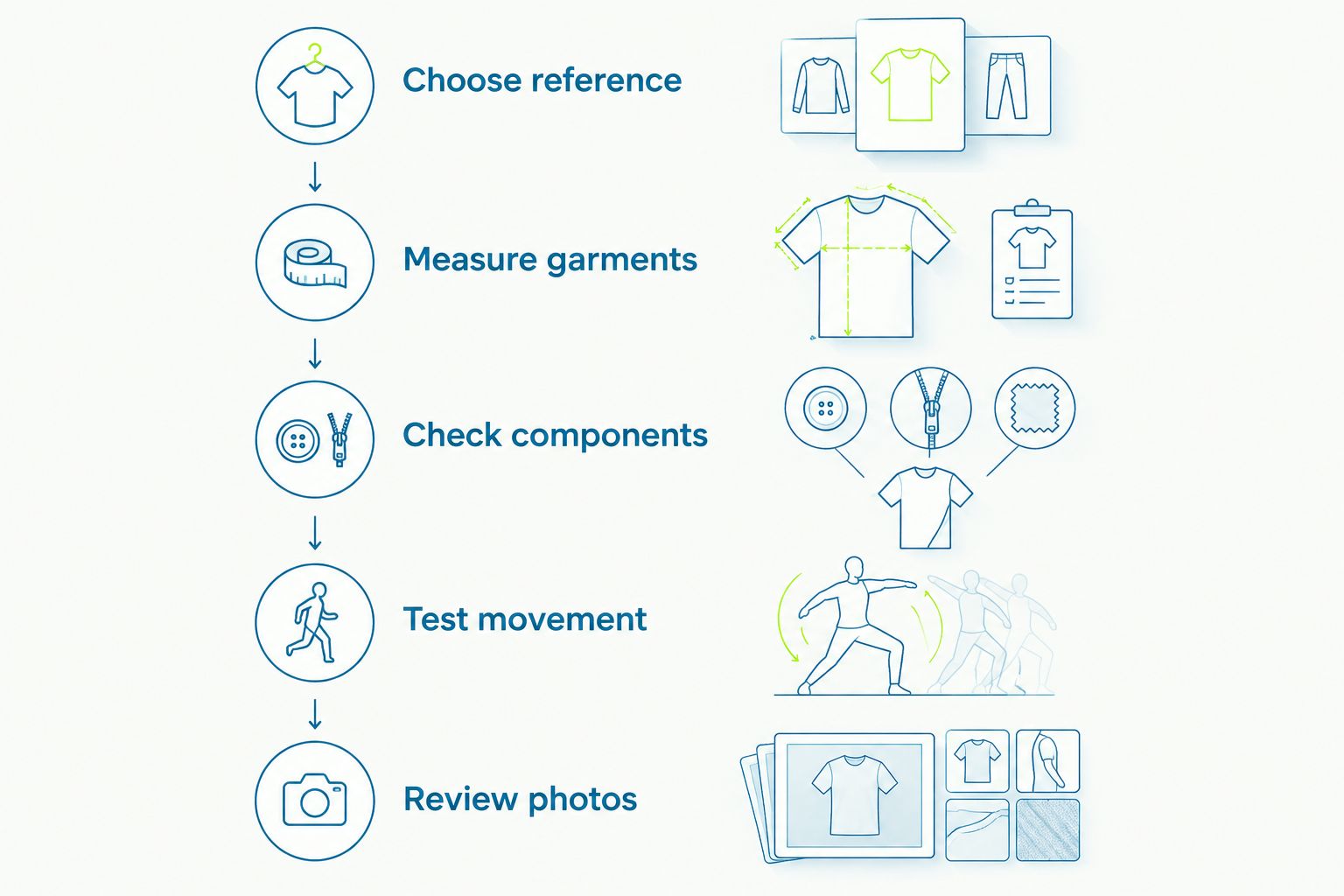
Follow this sequence rather than choosing by height alone:
- Choose reference: Save the exact character appearance you want to reproduce.
- Measure garments: Record 5 measurements: shoulder width, chest width, waist, sleeve length, and garment length. Keep centimeters or inches consistent.
- Check components: Separate the listed contents from accessories merely shown in photos.
- Test movement: Rehearse 3 poses: standing with arms raised, sitting, and your intended character pose.
- Review photos: Take 2 photographs, front and side, to check the outline and hem placement.
Ask whether the chart describes body measurements or finished garments. Those are not interchangeable: a finished garment needs room for your body and intended movement.
Treat vague fabric descriptions as unanswered questions, not proof of comfort. Check the care instructions before steaming, washing, or applying heat to a costume or wig.
HOW THE BUILDS ARE RANKED
This 2026 ranking prioritizes recognizable design, manageable components, and a clear use case. It assesses character builds against the criteria above; it does not assign construction scores to unnamed retail costumes or claim hands-on product testing.
Yuji takes the default slot because the red-hood uniform offers a defined starting point without a large signature prop. Gojo, Megumi, Nobara, and Nanami each serve a different preference: prop-free styling, wig work, skirt-based action, and tailoring.
WHICH COSTUME SHOULD YOU CHOOSE?
Choose Yuji Itadori if you have no strong character preference. Start with the hood, jacket proportions, and trouser fit, then finish the hair and footwear.
Choose Gojo for a prop-free look, Megumi for wig styling, Nobara for a skirt-based action build, or Nanami for separate-garment assembly. Your favorite character still wins when you are willing to handle that build’s specific work.
FAQ
What are the best Jujutsu Kaisen cosplay costumes for beginners?
Yuji Itadori’s school uniform is this guide’s default beginner pick. Its red hood provides a clear design checkpoint, and the core outfit does not require a large signature prop. Check fit and included components before selecting a set.
Is Gojo cosplay easier than Megumi cosplay?
Choose Gojo for a prop-free look and Megumi if you enjoy angular wig styling. Both require attention to the collar and hair. Gojo’s eye covering adds a visibility issue that Megumi’s build does not.
Can I make a Nanami cosplay from regular clothes?
You can assemble Nanami’s suit-based look from separate garments. Match the suit, shirt, patterned tie, glasses, and hairstyle to one reference; an ordinary light suit alone does not complete the character.
How do I choose the right size for an anime cosplay costume?
Compare the listing’s measurements with your body and a similar garment that fits. Confirm whether the chart gives body or garment measurements, and check shoulders, chest, waist, sleeves, and length separately.
Does a full cosplay set include the wig and shoes?
A full-set label does not establish which accessories are included. Read the contents for the exact option you select, and ask about any photographed wig, shoes, or props that are not explicitly listed.
Can I wear a Gojo blindfold while walking at a convention?
Do not walk in a blindfold that obstructs your vision. Remove it before moving, and reserve obstructive eye coverings for stationary photographs with assistance.
What should I check before bringing Nobara’s hammer to an event?
Check the event’s current prop rules before choosing Nobara’s hammer. Use a nonfunctional costume prop that meets those rules, and do not substitute real tools or sharp accessories.
ONE LAST THING
Photograph the costume with your arms relaxed before trying a dramatic pose. A strong pose can hide a twisted closure, uneven hem, or collapsed collar that will show in candid pictures.
For your 2026 build, fix that resting silhouette first. Rosemchale’s recommendation is direct: choose the character you want, then make the outfit work when you are not posing.