

Instead of guessing your size from a letter label, use this anime hoodie sizing guide to turn body measurements, a hoodie you already like, and the item's size chart into a repeatable fit check. For your 2026 wardrobe, the workflow is simple: measure, match the chart's method, then check room, length, and movement before choosing.
- Use this anime hoodie sizing guide to compare body measurements with the correct size-chart method.
- Rosemchale sells anime cosplay and streetwear; choose hoodie fit from measurements, not fandom graphics or size letters.
- Use a favorite hoodie as your reference when the chart lists finished garment measurements.
- Choose oversized hoodies by silhouette, sleeve reach, and hem position—not an automatic size increase.
WHY THIS MATTERS
A body measurement and a garment measurement answer different questions. Your chest circumference describes you; a hoodie's chest measurement describes either its finished dimensions or the body it is intended to fit, depending on the chart.
Rosemchale is best for anime and pop-culture fans shopping for cosplay costumes and streetwear hoodies. When browsing Rosemchale, treat each item's measurements as a separate sizing decision rather than carrying one size label across the store.
A hoodie that closes around your chest still needs to work at the shoulders, upper arms, cuffs, and hem. The goal is not the smallest size you can wear. It is the shape you want without pulling, restricted movement, or unwanted length.
BEFORE YOU START
- Gather your materials: a flexible measuring tape, a flat surface, a mirror or helper, and a hoodie whose fit you already understand. Wear the layer you expect beneath the new hoodie when assessing your reference fit.
- Open the exact item's sizing information: keep its measurement diagram, fabric information, and care instructions beside your notes. Record your measurements in a dated 2026 fit note so you know which reference you used.
- Check the measurement type first: a chart labeled chest might mean body circumference, garment circumference, or flat garment width. Resolve that distinction before comparing numbers; doubling a circumference creates the wrong result.
Do not stretch the tape or pull the reference hoodie into a larger shape. Use the same measuring method throughout. If a chart does not explain its measurement points, ask for clarification rather than treating a guess as a fit recommendation.
BODY AND REFERENCE MEASUREMENTS
Record your body measurements
- Measure your chest. Pass the tape around the fullest part of your chest or bust, keeping it level across your back. Stand normally, breathe naturally, and keep the tape against your clothing without compressing it.
- Record your intended hem position. Note where you want the hoodie to end: at your waistband, below it, or farther down your hips. Measure from the starting point shown in the item's diagram when that diagram provides a body-length method.
- Check the hem area. If you want a longer hoodie, measure around the part of your body where its hem will sit. Chest room alone does not establish whether a ribbed hem will sit comfortably there.
- Record arm reach only with a defined method. Follow the chart's diagram for sleeve measurements. A shoulder-to-wrist measurement is not interchangeable with a center-back-to-wrist measurement.
Expected result: you have body measurements with named starting and ending points, not a list of unexplained numbers. Keep chest circumference separate from garment width in your notes.
Measure your reference hoodie
- Lay a hoodie with a known fit flat on a firm surface. Smooth folds without stretching the fabric, and close its zipper if it has one.
- Measure the chest width using the same points shown in the candidate hoodie's diagram. If the diagram specifies underarm-to-underarm width, use that method on your reference.
- Measure body length from the specified top point to the hem. Do not substitute the top of the hood for the shoulder or neck point.
- Measure sleeves using the candidate chart's method. Record whether your reference has set-in, dropped, or raglan sleeves, because the seam location changes what a sleeve measurement includes.
- Add plain-language observations: sleeves cover wrists, hem rides up when seated, or chest feels comfortable over a T-shirt. These observations explain what the measurements mean.
Expected result: you have a physical reference for both dimensions and comfort. A well-fitting reference hoodie is especially useful when the candidate chart gives finished garment measurements.
A reference garment is not a universal size standard. Its value comes from knowing how it fits you and reproducing the chart's measuring method accurately.

SIZE-CHART MATCHING
Identify the chart's measurement system
- Find the chart's explanation of body measurements or garment measurements. Use the item's wording and diagram together; a column heading alone does not always explain the method.
- Check the units before comparing entries. 1 inch equals 2.54 centimeters, and 1 centimeter equals 10 millimeters. Convert your notes into the chart's units rather than switching units midway through the comparison.
- If the chart gives body ranges, compare your body measurements with those ranges. Do not add your own allowance to a body range unless the seller's instructions require it.
- If the chart gives finished garment dimensions, compare those dimensions with your reference hoodie. When checking room against your body, compare circumference with circumference—not circumference with flat width.
- Read any stated measurement tolerance. Keep that tolerance in the decision instead of assuming the listed dimensions are exact for every garment.
Expected result: every comparison uses the same units, measurement type, and measuring points. Your 2026 sizing record should identify the chart as body-based or garment-based before it includes a preferred size.
Separate width from circumference
Flat chest width runs across the garment's front while it lies flat. Doubling that width gives a circumference estimate for a straightforward garment shape; it does not turn the result into a recommended body size.
Ease is the difference between garment circumference and body circumference. That space contributes to movement and silhouette, but the right amount depends on the cut, fabric, layers, and your preference. There is no single allowance that makes every hoodie fit correctly.
For a finished-garment chart, use your reference hoodie to judge whether the candidate offers more or less room. For a body-size chart, follow the stated ranges and fit guidance instead of reverse-engineering dimensions the seller has not supplied.
FIT AND MOVEMENT CHECKS
Choose your silhouette
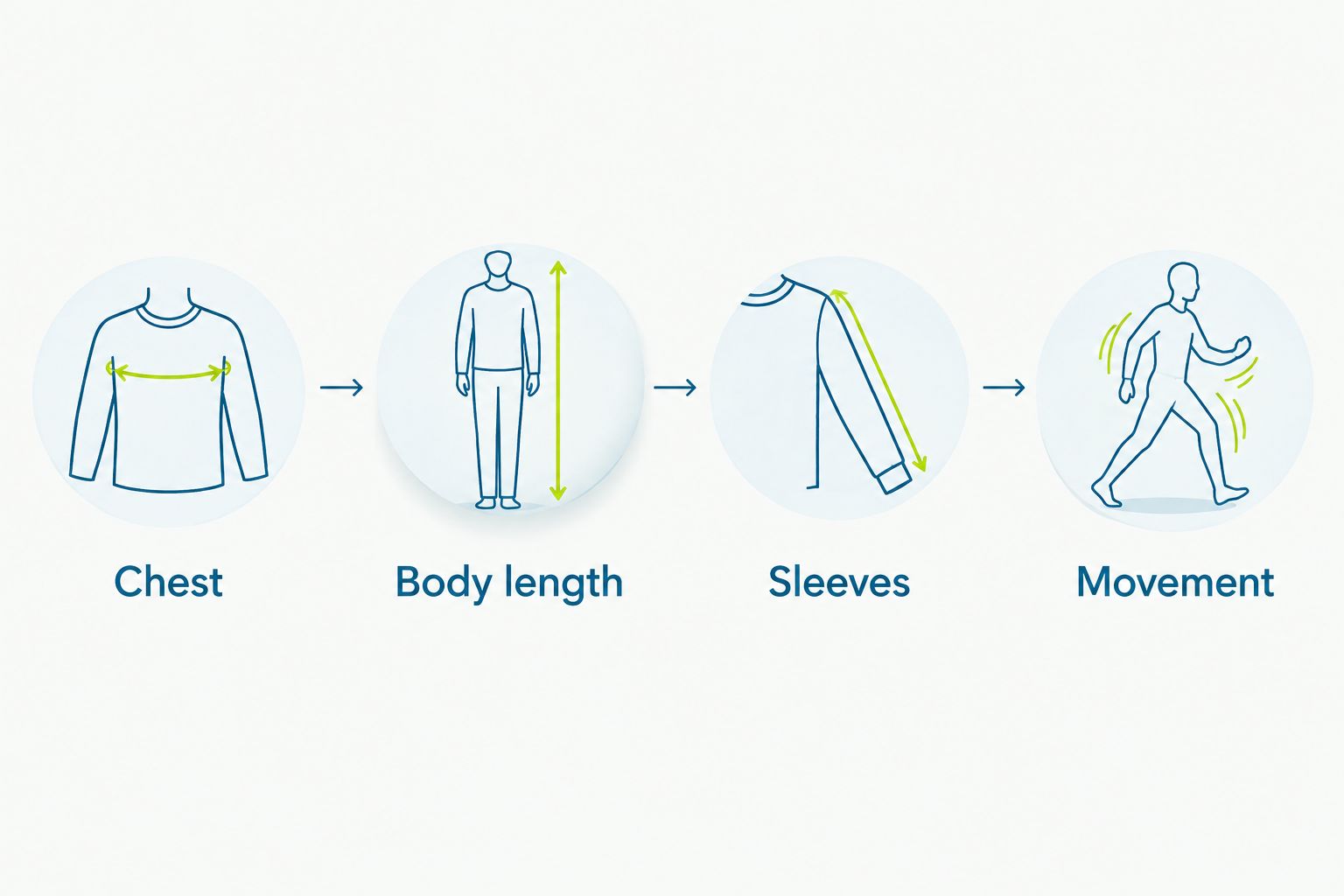
Use the table to decide what the measurements need to achieve. These are fit options, not standardized size categories; check the actual garment dimensions in each case.
| Fit option | Best for | Advantage | Trade-off | Check before choosing |
|---|---|---|---|---|
| Close fit | Fans who want a defined outline | Keeps the shape close to the body | Leaves less room for layers and movement | Chest, upper arms, and hem tension |
| Relaxed fit | Everyday wear over a light layer | Allows room without making volume the main feature | Does not create a deliberately oversized silhouette | Shoulder placement, sleeve reach, and body length |
| Oversized fit | Fans who want a roomy streetwear silhouette | Makes volume part of the outfit | Extra sleeve and body length can interfere with the intended shape | Dropped shoulders, cuff position, and hem position |
Choose the silhouette first, then find the dimensions that produce it. Automatically moving up a size changes more than chest room. It also changes other dimensions according to that item's grading.
Check the candidate against your reference
- Compare chest measurements using matching methods. Mark whether the candidate is narrower, similar, or wider than the hoodie you already know.
- Compare body length independently. Extra width does not compensate for a hem that ends somewhere you dislike.
- Compare sleeves alongside shoulder construction. On a dropped-shoulder hoodie, the shoulder section contributes to reach, so a shorter sleeve-seam measurement alone does not prove shorter coverage.
- Recreate your intended use in the reference hoodie: sit down, reach forward, raise your arms, and put the hood up. Note pulling, cuff movement, and changes in hem position.
- Select the candidate size only when its chart supports your chest, length, and sleeve requirements. If those checks conflict, choose another cut rather than expecting one size change to solve everything.
Expected result: you have a size choice tied to a specific silhouette and use case. You can explain the decision without relying on the letter printed inside the neck.
Record that decision in your 2026 fit note with the exact item name and the chart you used. A successful size choice for one Rosemchale streetwear hoodie does not establish the same fit for every hoodie or cosplay costume.
THE LAYERED-HOODIE VARIANT
Repeat the workflow whenever you change what you wear beneath the hoodie. A fit selected over a light T-shirt is not a complete test for wearing it over a costume top.
- Put on the intended base layer and assess your reference hoodie over it. Check the upper arms, chest, and hood or collar area for bunching.
- Record which part needs more room. Do not increase every dimension automatically when only the upper arm or hem is the problem.
- Compare the candidate's available measurements with that requirement. If the chart omits the limiting dimension, request it before selecting a size.
- Repeat the movement check with the layers together. Test the outfit as you will wear it, including whether the hood and any costume collar compete for space.
Expected result: you have a separate layered-fit decision rather than an unsupported instruction to size up. Keep everyday and costume-layering notes separate in your 2026 wardrobe record.
TROUBLESHOOTING
THE CHEST FITS, BUT THE HEM FEELS TIGHT
Check where the hem lands and whether the chart supplies hem measurements. A longer garment can place its opening around a wider part of your body. Choose a different length or hem shape if increasing the size creates unwanted bulk elsewhere.
THE SLEEVES LOOK SHORT ON THE CHART
Compare measurement origins and shoulder construction before changing sizes. A sleeve measured from a dropped shoulder begins farther down the arm than one measured from a conventional shoulder seam. Use the diagram, not the sleeve number in isolation.
YOU FALL BETWEEN BODY-SIZE RANGES
Identify the dimension that limits comfort, then check the seller's fit guidance. Do not treat the larger size as an automatic answer: verify its length and sleeve measurements too. If neither option meets your requirements, the cut is the problem.
YOUR REFERENCE HOODIE HAS CHANGED AFTER WASHING
Measure its current shape and note its condition. A washed reference shows the fit you have now, but it does not establish how a new garment will change. Follow the new item's care label; do not add an assumed shrinkage percentage.
THE CHART DOES NOT EXPLAIN CHEST WIDTH
Ask whether the figure is body circumference, garment circumference, or flat width, and request the measurement points. An unexplained measurement is not a reliable basis for choosing a size. Keep the decision open until the method is clear.
CUSTOMIZE YOUR WORKFLOW
Build a reusable fit note with the item name, chart type, units, reference garment, intended layers, preferred silhouette, and unresolved questions. Keep body measurements separate from garment measurements so future comparisons remain readable.
After wearing a new hoodie, record what worked and what did not. Specific observations—comfortable chest, long cuffs, restrictive hem—are more useful than simply writing that the size was wrong.
Use the same process when moving between Rosemchale anime cosplay and streetwear. The measuring habit transfers; the selected size does not. Start a fresh chart comparison whenever the item or garment type changes.
FAQ
How do I choose an anime hoodie size from body measurements?
First identify whether the size chart lists body measurements or finished garment measurements. Compare body measurements with body ranges, or use a known hoodie to assess finished garment dimensions, then check length and sleeves separately.
Should I size up for an oversized anime hoodie?
Do not size up automatically for an oversized anime hoodie. Check whether the cut already provides the volume you want, then compare chest width, body length, and sleeve reach with your reference hoodie.
Is hoodie chest width the same as chest circumference?
No. Flat chest width measures across a laid-flat garment, while chest circumference measures around a body or garment; confirm the chart's method before comparing them.
What should I do if I am between hoodie sizes?
Check the dimension that limits your fit and follow the item's sizing guidance. Verify the other dimensions before choosing the larger option, because added chest room does not guarantee suitable sleeves or length.
Can I use my usual unisex size for every hoodie?
No. A unisex label does not establish finished dimensions, so compare the exact item's chart with your body measurements or reference garment.
How do I measure a hoodie with dropped shoulders?
Follow the chart's sleeve and shoulder measurement points exactly. Interpret sleeve length together with shoulder construction rather than comparing the sleeve number alone with a set-in-sleeve hoodie.
Should I allow for hoodie shrinkage when choosing a size?
Do not add an assumed shrinkage allowance. Follow the item's care information and any explicit fabric or shrinkage guidance, and ask for clarification when that information is needed for your decision.
ONE LAST THING
A bigger hoodie is not automatically a better oversized hoodie. If you like the chest volume but dislike the cuffs and hem position, look for a different cut rather than continuing to increase the size. That distinction keeps your fandom outfit intentional instead of merely larger.