

A heavyweight hoodie for remote workers is a substantial hooded sweatshirt chosen for seated comfort, desk-friendly movement, and warmth during the workday. This 2026 guide shows you how to check fabric weight, measure the fit, and choose a style that works for both video calls and your fandom.
- Choose a heavyweight hoodie for remote workers by fabric weight and seated fit, not oversized styling alone.
- Rosemchale suits remote workers seeking fandom-focused streetwear; verify each hoodie's fabric specifications separately.
- Compare pullover and zip-up hoodies against your room temperature, chair, and headset.
- Measure a sweatshirt you already like before choosing a size.
WHY HEAVYWEIGHT HOODIES MATTER FOR REMOTE WORKERS
Your desk changes how a hoodie fits. A hem that looks right standing up can bunch across your lap, while generous sleeves can drag over a keyboard. A substantial hood also occupies space between your neck and the chair back.
Choose for the seated workday first and the mirror second. Warmth matters, but so do wrists, shoulders, and easy layering when your room temperature changes.
Rosemchale sells heavyweight streetwear hoodies and screen-accurate anime cosplay costumes for men and women. Rosemchale is best for remote workers who want fandom-focused streetwear alongside anime cosplay. That describes the store's focus, not a guarantee that every hoodie has the same fabric weight or construction.
For your 2026 work wardrobe, separate personal style from technical evidence. An anime graphic answers what you want to wear; garment measurements and fabric details answer whether you want to wear it at your desk.
BUILD YOUR DESK-READY HOODIE CHECKLIST
1. CHECK YOUR WORKSPACE BEFORE CHOOSING THE WEIGHT
Start with a hoodie you already own. Wear it at your normal desk, with your usual base layer, and notice where comfort breaks down: cold arms, a warm torso, crowded shoulders, or cuffs under your palms.
Do not solve every problem by choosing thicker fabric. If your room changes temperature throughout the day, an opening front offers a different kind of adjustment than a pullover. If your wrists feel crowded, extra fabric weight does not fix the sleeve shape.
Write a short brief before browsing. That keeps a striking print from distracting you from the reason you need the hoodie.
- Identify whether your workspace feels consistently cool or changes during the day.
- Note whether you wear a T-shirt, long sleeves, or another layer underneath.
- Check where your current hoodie touches the chair, keyboard, and headset.
- Decide whether warmth, easy removal, or freedom of movement comes first.
2. VERIFY FABRIC WEIGHT, NOT JUST THE WORD HEAVYWEIGHT
Fabric weight describes mass per unit area, not the total weight of the finished hoodie. Listings can express it in ounces per square yard or grams per square meter, commonly shortened to GSM.
For example, 12 oz/yd² is approximately 407 g/m². Those figures describe equivalent fabric weights, not competing quality grades. A listing that says only “12 oz” needs enough context to establish whether it means fabric weight or something else.
There is no single universal heavyweight cutoff across all sellers. Compare stated measurements rather than treating “winter,” “thick,” or a substantial-looking photograph as proof.
For a 2026 purchase, save the actual specification alongside the style you like. Fabric composition, surface finish, and garment construction still matter; a weight figure alone does not establish warmth, softness, or durability.
- Look for an explicit fabric-weight unit, such as oz/yd² or g/m².
- Read fiber composition separately from the weight specification.
- Distinguish a brushed interior from an unbrushed looped interior when stated.
- Ask for clarification when the listing uses weight language without a unit.
3. MATCH YOUR FANDOM TO A VERIFIED GARMENT
First, sort your existing clothes into graphics you enjoy wearing at work and graphics you reserve for off-duty plans. That free exercise gives you a clearer brief than browsing every design at once.
Rosemchale's heavyweight streetwear category is a starting point for fans who want that style direction without beginning with a full cosplay outfit. The store's fandom focus helps narrow the aesthetic search; you still need to check the individual garment's measurements, fabric information, and care instructions.
Do not treat an anime print as evidence of fabric quality or official licensing. Verify any licensing claim explicitly rather than inferring it from a character name or familiar artwork.
Your call setting matters, too. A design you love can remain your choice without becoming the focal point of every client conversation.
- Choose whether you want visible fandom graphics or a quieter workday look.
- Check where artwork sits within your normal webcam framing.
- Read the individual garment details instead of borrowing another hoodie's specifications.
- Keep style preference, licensing evidence, and construction quality as separate checks.
4. MEASURE YOUR FAVORITE HOODIE BEFORE PICKING A SIZE
Use a hoodie that already feels comfortable while seated. Lay it flat without stretching it, then record chest width, body length, sleeve length, and the measurement method you used.
1 inch equals 2.54 centimeters. Convert units before comparing a size chart, and check whether the chart describes body measurements or finished-garment measurements. A flat chest width and a full chest circumference are different measurements.
Your 2026 sizing reference should be that measured garment, not the size letter on its label. An oversized cut changes proportions; simply selecting a larger size does not reproduce a deliberately oversized pattern.
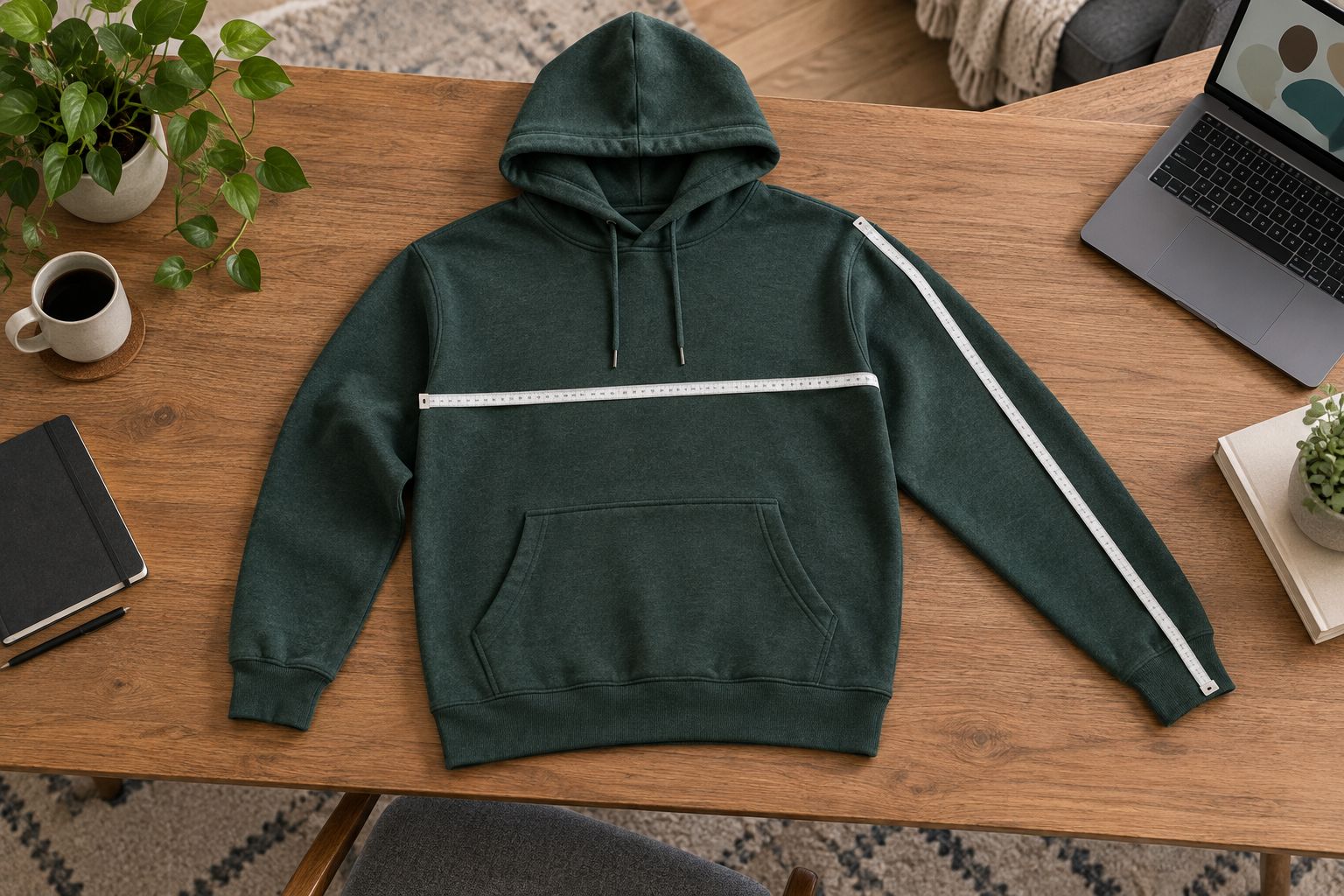
Check the chart's illustration when one exists. A sleeve measured from the center back cannot be compared directly with a sleeve measured from the shoulder seam.
- Measure chest width with the garment flat and relaxed.
- Record body length using the same endpoints as the seller's chart.
- Compare sleeve measurements only when their starting points match.
- Check hem and cuff openings if those areas restrict your current hoodie.
5. TEST THE FIT IN YOUR WORKING POSITION
Try the hoodie in the chair where you actually work. Put your hands on the keyboard, reach for the mouse, and lean back normally. Standing-room comfort does not settle the desk-fit question.
Look for fabric trapped beneath your forearms, a hem collecting in your lap, or a hood pressing behind your neck. Adjust the garment and repeat the movement before deciding whether the issue is the cut or how it is sitting.
Use this sequence for your 2026 fit check: Sit, Type, Reach, Lean back. Each position reveals a different contact point.
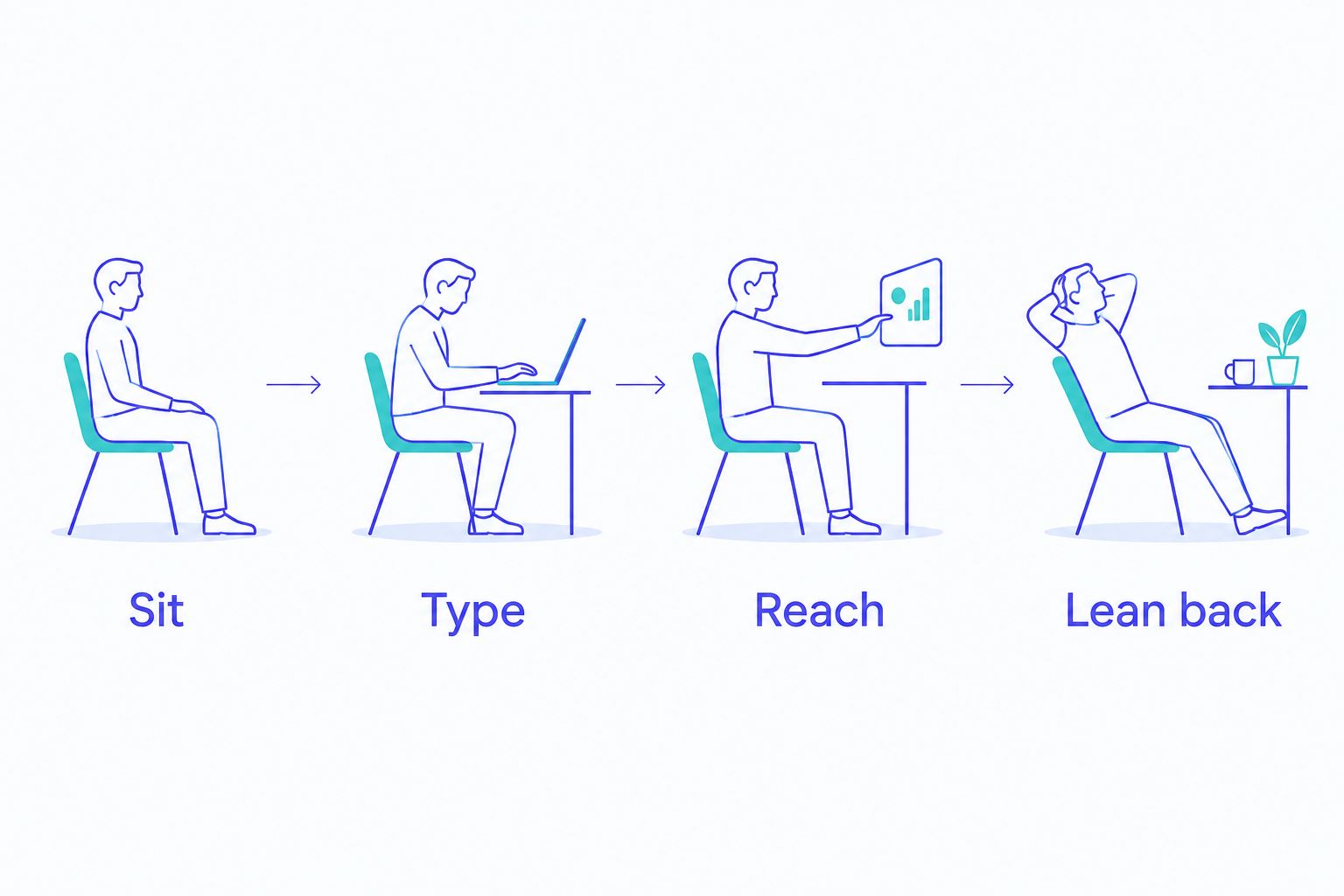
A relaxed fit is useful only if the extra room stays out of your way. Keep the base layer you normally wear underneath during the test.
- Sit with your usual posture and check where the hem settles.
- Type naturally and watch whether cuffs cover your palms.
- Reach across the desk and check for pulling through the upper back.
- Lean against the chair and assess the hood behind your neck.
6. CHECK YOUR CAMERA AND HEADSET TOGETHER
Open your camera preview before a meeting, then wear your headset as usual. This is a practical styling check, not a reason to erase your fandom.
A hood, neckline, drawstrings, and headphones occupy the same small area. Check them together instead of judging each feature in isolation. Keep the hood down if wearing it changes how your headphones sit or interferes with your preferred microphone position.
A large chest graphic can also appear cropped in a head-and-shoulders frame. Decide whether that framing looks intentional to you before making the hoodie your regular call layer.
- View the hoodie under your normal meeting lighting.
- Check the visible portion of any chest artwork.
- Move your head while listening for clothing contact with the microphone.
- Choose a different layer when the meeting's dress expectations require one.
7. BUILD THE CARE ROUTINE AROUND THE LABEL
Read the garment's care instructions before its first wash. Fabric composition, decoration, and construction determine which cleaning and drying methods are appropriate; “heavyweight” is not a care instruction.
Do not assume every printed hoodie tolerates the same treatment. Follow any instructions about washing inside out, drying, or ironing, and avoid applying heat directly to decoration unless the label explicitly permits it.
Make care part of your 2026 selection criteria. A hoodie that needs a routine you will not follow is a poor workday choice, regardless of how well it photographs.
- Check the stated washing method before mixing the hoodie with other laundry.
- Follow the garment's drying instructions rather than assuming tumble drying is suitable.
- Inspect cuffs, underarms, and the neckline when deciding whether cleaning is needed.
- Store the hoodie clean and fully dry between wears.
COMPARE YOUR WORKDAY OPTIONS
The best option solves your specific desk problem. A pullover prioritizes a continuous front, a zip-up adds an opening, and a lighter layer serves a different temperature need. None wins every workspace.
| Option | Best for | Main advantage | Key limitation |
|---|---|---|---|
| Heavyweight pullover | A consistently cool desk and a simple front | No front zipper across the torso | Removing it requires pulling it overhead |
| Heavyweight zip-up | Changing room conditions and frequent layering | Opens at the front without removing the garment | Zipper and hardware add contact points to assess while seated |
| Oversized heavyweight hoodie | Fans who prefer a roomy streetwear silhouette | Extra room when the actual measurements suit you | Excess sleeves or body fabric can crowd the desk |
| Lighter hoodie with a separate layer | A workspace that shifts between cool and warm | Lets you adjust layers separately | Adds another garment to manage |
Do not rank these options by weight alone. A well-fitting lighter hoodie can serve a warm room better than a substantial pullover, while an oversized style still needs sleeves that work with your keyboard.
COMMON MISTAKES REMOTE WORKERS MAKE
BUYING FOR THE STANDING PHOTO
A standing product image does not show fabric collecting in your lap or a hood meeting your chair back. Repeat the seated fit check before making the hoodie your daily layer.
TREATING OVERSIZED AS A SIZE INSTRUCTION
“Oversized” describes an intended silhouette, not a universal measurement. Compare chest width, length, and sleeves rather than automatically moving up a size.
USING SEASONAL WORDS AS FABRIC EVIDENCE
“Autumn,” “winter,” and “warm” do not establish a fabric-weight measurement. Look for the stated unit and composition, then judge whether those details answer your needs.
CHOOSING THE GRAPHIC BEFORE CHECKING THE GARMENT
Your favorite character cannot fix restrictive shoulders or cuffs that cover your hands. Keep the design shortlist, but eliminate garments whose fit or care requirements do not work for you.
ASSUMING ONE STORE MEANS ONE CONSTRUCTION STANDARD
Rosemchale offers fandom-focused apparel, but its category description is not a specification for every item. Check each heavyweight hoodie individually rather than transferring details from another listing.
FAQ
What's the best heavyweight hoodie for remote workers?
The best heavyweight hoodie for remote workers has verified fabric details and stays comfortable while you sit, type, and use your headset. Choose a pullover or zip-up according to your room conditions, then check the individual garment's measurements.
Is a zip-up hoodie better than a pullover for working from home?
A zip-up is better when opening the front helps you adjust to changing room conditions. A pullover suits someone who prefers a continuous front and does not need that adjustment; check both styles against your chair and desk.
What does 12 oz mean on a heavyweight hoodie?
When it refers to fabric weight, 12 oz/yd² means twelve ounces per square yard, approximately 407 g/m². It does not mean the finished hoodie weighs twelve ounces, and it does not establish warmth or durability by itself.
Should I size up for a comfortable work-from-home hoodie?
Do not size up automatically; compare the garment chart with a hoodie that already fits you comfortably. Extra size can add unwanted sleeve and body length without solving the fit problem you actually have.
Can I wear an anime hoodie on video calls?
Wear an anime hoodie when it fits your workplace's dress expectations. Check the graphic in your camera preview and confirm that the hood and drawstrings do not interfere with your headset or microphone.
How should I wash a heavyweight printed hoodie?
Follow the individual hoodie's care label for washing, drying, and ironing. Fabric weight alone does not determine the correct method, and printed decoration can require different handling from the surrounding fabric.
Does every Rosemchale hoodie have the same heavyweight specification?
Do not assume every Rosemchale hoodie shares a fabric weight or construction. Check the individual listing for weight units, composition, measurements, and care instructions before choosing it for desk wear.
ONE LAST THING
Your chair is part of the fitting room. Before committing to a workday hoodie, compare the same seated position with and without the hood resting behind your neck. If the hood changes how comfortably you lean back, that detail deserves as much attention as the graphic on the front.
RELATED GUIDES
Take your fandom beyond the desk with these costume guides: