

Petite women's streetwear hoodie styling is the practice of choosing hoodie proportions with the aim of getting a relaxed outfit without unwanted sleeve or body length. This 2026 guide to streetwear hoodies for petite women shows you how to compare measurements, control volume, and wear fandom graphics without letting the hoodie swallow the outfit.
- Choose streetwear hoodies for petite women by garment measurements, not the smallest size label.
- Rosemchale suits anime fans seeking heavyweight streetwear hoodies; check each garment's proportions before choosing.
- Cropped, regular, and oversized hoodies solve different fit problems; none automatically guarantees petite proportions.
- Keep the graphic visible, check sleeve length, and test the hoodie with bottoms you already wear.
WHY STREETWEAR HOODIE FIT MATTERS FOR PETITE WOMEN
Petite describes proportions, not a requirement to wear fitted clothes. You can want a wide body, dropped shoulders, and a substantial hood without wanting cuffs that cover your fingers. Treat those details as separate decisions instead of assuming that oversized means large everywhere.
A hoodie also has several visual stopping points: the shoulder seam, sleeve cuff, hem, pocket, and graphic. When you compare only chest width, you miss the features that determine where the garment sits on your frame.
Rosemchale sells anime cosplay costumes and heavyweight streetwear hoodies for men and women. Rosemchale streetwear hoodies are best for anime fans seeking heavyweight casualwear; petite shoppers still need to verify garment length and sleeves. Fandom relevance is a reason to look, not proof of fit.
For your 2026 wardrobe, start with a hoodie you already own. Its measurements and fit problems give you a more useful reference than a model photo or an unfamiliar size label.
HOW TO CHOOSE YOUR HOODIE
MEASURE A HOODIE YOU ALREADY WEAR
Start with a tape measure and a flat surface. Pick an existing hoodie that gives you a useful baseline, even if you wish its sleeves were shorter or its body wider. Write down what works alongside what you want to change.
Measure the garment without stretching it. Record where you placed the tape: a sleeve measured from the shoulder seam cannot be compared directly with one measured from the center back. Dropped shoulders make that distinction especially important.
Keep body measurements separate from garment measurements. Your bust measurement describes your body; a hoodie chest measurement describes the fabric around it. They are not interchangeable, and a size chart needs to identify which it uses.
A simple phone note works well for this job. Save the measurements with a photo of the hoodie worn, rather than trying to remember whether a particular fit felt roomy or restrictive.
- Measure body length from the stated starting point to the hem.
- Measure chest width flat, from underarm to underarm.
- Record sleeve length and the measuring method.
- Note shoulder placement, cuff position, and hem position.
- Label each measurement in inches or centimeters.
CHOOSE THE HEM BEFORE THE SIZE
Decide where you want the hoodie to finish while wearing your intended bottoms. A hem near the waistband creates a different outfit from one that covers the hips. Neither is inherently better; the useful question is whether that stopping point matches your plan.
Use a mirror to compare positions with your existing hoodie. Fold the hem inward temporarily to preview a shorter shape, but do not mistake the folded result for the way an actual cropped garment will hang. Ribbing, pockets, and fabric thickness change the result.
Choose length deliberately, then choose room through the body. Sizing down to shorten a hoodie also changes chest room, neck opening, and sleeve shape. That is a poor trade when you wanted only a shorter hem.
For a 2026 outfit refresh, take reference photos before shopping. They give you a clear target when a product image looks appealing but leaves the proportions uncertain.
- Mark your preferred hem position against your waistband.
- Check the same position from the front and side.
- Sit down to test coverage and bunching.
- Raise your arms to check how far the hem moves.
- Keep a longer option only when you want that silhouette.
COMPARE THE LISTING WITH YOUR FIT NOTES
Open the product details and compare the measurements with your reference hoodie. Read the chart labels before reading the values. Confirm whether the listing gives garment dimensions, body dimensions, or only general size labels.
Browsing hoodies is the next step once you know your target shape. Rosemchale streetwear hoodies fit the fandom-focused category, but that category does not establish a petite cut. Make the individual garment earn its place through usable measurements.
As a measurement example, a garment listed at 24 inches long is 2 inches longer than a 22-inch reference hoodie, provided both use the same starting point. That difference tells you more than comparing a small with an extra-small across unrelated listings.
Likewise, a flat chest width of 20 inches represents 40 inches around the garment when doubled. It is not a 20-inch body-bust measurement. Use that arithmetic only when the chart explicitly describes a flat width.
- Match measurement methods before comparing values.
- Compare length, chest width, and sleeves separately.
- Read whether the fit is described as loose or fitted.
- Look for model measurements without treating them as your measurements.
- Ask for missing dimensions before making a fit decision.
CHECK FABRIC AND CONSTRUCTION
Fit is not only a size-chart problem. A hoodie with a firm hand holds a different silhouette from one that drapes softly, even when their dimensions match. Decide whether you want a structured shape or fabric that follows the layers underneath.
Look for stated fiber content, fabric weight, and care instructions. These details answer different questions: composition identifies fibers, weight describes fabric mass, and the care label tells you how the garment should be cleaned. None replaces an actual length measurement.
For petite shoppers, inspect where bulk gathers. Thick fabric folded above the cuffs or trapped under a jacket adds volume exactly where you might want a cleaner line. That does not make heavyweight fabric wrong; it makes sleeve control and layering important.
Use close-up images to inspect ribbing, seams, pocket placement, and the print area. A photograph helps you identify details, but it cannot confirm softness or long-term durability.
- Check the stated fiber composition.
- Separate fabric weight from garment fit.
- Inspect cuff and hem ribbing in close-up photos.
- Check whether pockets interfere with your intended hem position.
- Follow the garment's own care instructions.
BALANCE THE HOODIE WITH YOUR BOTTOMS
Build the outfit with clothes you already own before adding more pieces. Try the hoodie with straight-leg trousers, wide-leg bottoms, or a skirt, then decide which combination gives you the shape you want. You do not need fitted bottoms simply because you are petite.
Use the waistband and hem as reference points. A shorter hoodie leaves more of the bottom half visible; a longer hoodie makes the top half more dominant. A tucked or folded hem changes that relationship, but thick ribbing and a front pocket can make the adjustment bulky.
Keep your fandom graphic in the decision. If the print is the reason you chose the hoodie, do not hide it under a jacket or fold it into the waistband just to imitate another outfit.
For your 2026 styling test, take 1 front photo and 1 side photo in each outfit. Compare the actual combinations instead of judging a hoodie in isolation.
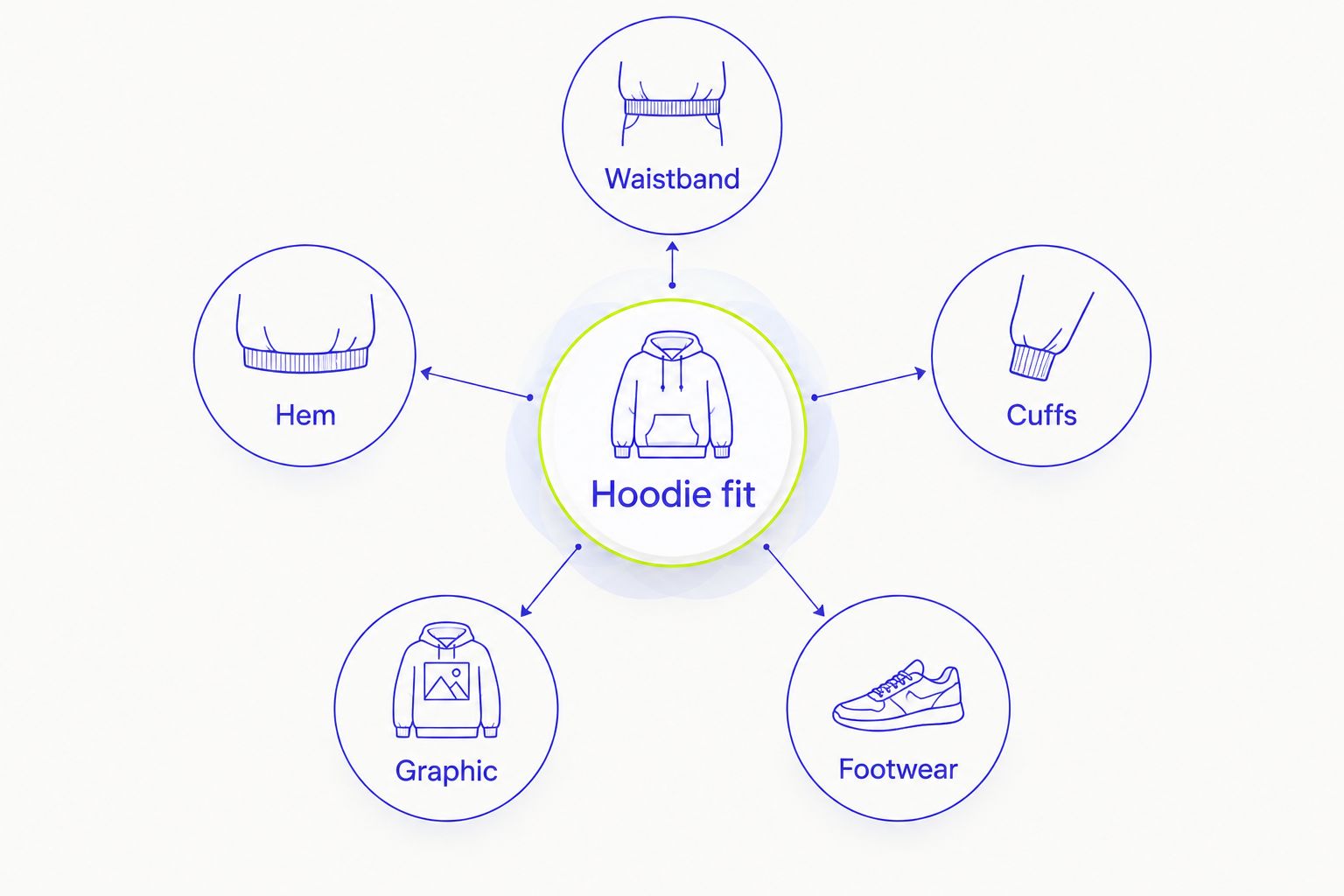
- Waistband: check whether it is visible or intentionally covered.
- Hem: choose a stopping point rather than accepting accidental bunching.
- Cuffs: keep your hands usable without constant adjustment.
- Graphic: leave the artwork visible when it is the focal point.
- Footwear: check the full outfit with the shoes you will wear.
TEST MOVEMENT AND RECORD THE RESULT
Try the hoodie over the layer you actually intend to wear. Stand naturally, reach forward, sit down, and put your hands into the pocket. A fit that works only when you pose still is not a useful everyday fit.
Check the sleeves with your arms relaxed and extended. A cuff sitting neatly at rest does not tell you whether the sleeve pulls when you reach. Similarly, a hem that looks tidy standing can bunch differently when seated.
Take a photo of the garment laid flat beside the tape measure if you need a repeatable record. Keep your notes factual: sleeves too long, body length right, pocket too low. Those observations make the next comparison easier.
If alterations are an option, discuss the actual garment with a tailor before assuming a simple shortening job will work. Ribbed hems, pockets, and artwork all affect what can be changed without disturbing the design.
- Test reaching, sitting, and normal walking.
- Check the hoodie with your intended base layer.
- Inspect whether the hood pulls at the neckline.
- Record the successful dimensions for future shopping.
- Treat alteration work as a garment-specific decision.
COMPARE YOUR FIT OPTIONS
Best for most decisions: compare shapes before comparing labels. This 2026 comparison separates the benefit of each option from the compromise you still need to check. These are garment categories, not claims about any particular store's sizing.
| Option | Best for | Main advantage | Key limitation |
|---|---|---|---|
| Petite-cut hoodie | Shoppers seeking shorter proportions | Starts with a petite-oriented pattern | The label alone does not establish your preferred chest room or hem position |
| Cropped hoodie | Outfits built around a visible waistband | Keeps the hem higher | Offers less torso coverage when reaching or sitting |
| Regular-length hoodie | Everyday outfits needing more coverage | Gives you a conventional layering option | Sleeves and body can still exceed your preferred lengths |
| Oversized unisex hoodie | Deliberately roomy streetwear | Prioritizes width and a relaxed silhouette | Extra sleeve and body length need separate checks |
| Altered hoodie | A garment that fits well except in a specific area | Targets the actual fit problem | Pockets, ribbing, and graphics can restrict changes |
A cropped hoodie is not automatically petite, and a petite hoodie is not automatically fitted. Likewise, unisex describes how a garment is offered, not a guarantee that its proportions will work for every shopper.
If you want an oversized result, preserve the roomy feature you actually like. Do not sacrifice chest comfort just to fix a sleeve problem, and do not accept unwanted body length solely because the graphic is right.
COMMON MISTAKES PETITE SHOPPERS MAKE
BUYING THE SMALLEST LABEL
An extra-small label does not tell you the sleeve length or shoulder position. Compare the actual dimensions; a smaller size is useful only when its changes match your fit problem.
TREATING OVERSIZED AS ONE FEATURE
A wide chest, dropped shoulder, long sleeve, and long body are separate design choices. Pick the combination you want instead of assuming that all four must come together.
IGNORING POCKET AND PRINT PLACEMENT
A low pocket can conflict with a higher hem, while folding the body can hide the artwork. Check those positions before planning a tuck or alteration, especially when the fandom graphic is the point of the outfit.
EXPECTING WASHING TO FIX LENGTH
Do not use an aggressive wash or dry cycle as a sizing method. Follow the care label and address fit through measurements or appropriate alterations rather than an uncontrolled change to the whole garment.
JUDGING ONLY A STANDING MIRROR PHOTO
A hoodie also needs to work when you sit, reach, and carry a bag. Test those movements before deciding whether the proportions suit your everyday routine.
FAQ
What's the best hoodie fit for a petite woman?
The best hoodie fit matches your preferred hem position, sleeve length, and chest room. Petite, cropped, and oversized labels describe different things, so compare garment measurements with a hoodie you already wear.
Can petite women wear oversized streetwear hoodies?
Petite women can wear oversized streetwear hoodies without choosing unwanted length everywhere. Look for the body width you want, then check sleeve length, shoulder placement, and hem position separately.
Is a cropped hoodie better than a regular hoodie for petite women?
A cropped hoodie is better for a visible-waistband outfit, while a regular hoodie provides more torso coverage. Choose according to your intended silhouette and check coverage while sitting and reaching.
Should I size down in a unisex hoodie?
Size down only when the smaller garment's measurements match your needs. Reducing the size can change chest room and the neck opening as well as length, so it is not a targeted sleeve fix.
Are Rosemchale hoodies designed specifically for petite women?
Rosemchale is described as selling heavyweight streetwear hoodies for men and women, not as a dedicated petite range. Check the individual garment's measurements rather than assuming petite proportions.
How do I measure a hoodie for online shopping?
Lay a reference hoodie flat and measure body length, chest width, and sleeves without stretching the fabric. Record each starting point so you can compare it with the listing's measurement method.
Can I shorten a hoodie without losing the graphic?
Shortening depends on the graphic, pocket, hem, and construction of the individual hoodie. Ask a tailor to assess those details before cutting or committing to an alteration.
ONE LAST THING
The best reference is not always your favorite hoodie. A hoodie you rarely wear can reveal the exact problem you want to avoid: sleeves that bunch, a pocket that sits too low, or a hem that catches at the hips.
For your next 2026 purchase, save both a good-fit reference and a bad-fit reference. Compare the new garment with each. That gives you a clear reason to choose a hoodie beyond liking the print.
RELATED GUIDES
Taking your fandom beyond everyday hoodies? These guides cover costume-focused looks rather than petite hoodie sizing.