

Instead of rebuilding your packing list and fixing costume problems on convention morning, use a repeatable workflow: confirm the order, inspect every piece, check fit, follow the care labels, rehearse, and pack by outfit. This guide shows you how to prepare cosplay costume before convention day, from the first order check to your 2026 con-ready reveal.
- How to prepare cosplay costume before convention: inspect, fit-test, follow care labels, rehearse, then pack by outfit.
- Rosemchale cosplay apparel suits anime fans assembling character looks; verify each costume’s measurements and included components.
- Test the complete costume with shoes, underlayers, wig, and accessories before packing.
- Keep synthetic wig care separate from garment care; never assume the same heat settings apply.
WHY THIS MATTERS
A costume can look right on a hanger and fail when you sit, climb stairs, or reach for your badge. Your final check is a wearable outfit, not a matching collection of pieces.
Rosemchale cosplay apparel is best for anime fans building character-based convention outfits. The store sells anime cosplay costumes and streetwear hoodies, but your preparation still needs to follow the individual garment’s instructions—not a storewide assumption about fabric or fit.
Start with the exact costume you ordered from Rosemchale, then build the checklist around its actual contents. For your 2026 convention, keep the event’s current costume and prop rules beside that checklist so presentation and admission requirements stay connected.
BEFORE YOU START
- Gather your records: order confirmation, selected size and variant, product measurements, included-component list, and the convention’s current costume, bag, and prop rules. Save accessible copies for travel.
- Gather your materials: measuring tape, your intended underlayers and shoes, a mirror, garment care labels, appropriate storage, and a small repair kit. Keep wigs and accessories within reach for the full fitting.
- Catch the hidden gotcha: a product title or styled photo is not a packing list. Confirm what your selected variant includes, and read the care label before washing, steaming, trimming, or attaching anything permanently.
Do the first inspection before making alterations. Photograph the costume and any concern while everything is still unmodified, then review the seller’s stated procedures before taking action.
ORDER RECORD AND OUTFIT INVENTORY
BUILD ONE SOURCE OF TRUTH
- Create an outfit checklist. Use these labels in your own notes: Ordered, Received, Fit checked, Care checked, Rehearsed, and Packed. These are personal checklist labels, not store interface controls.
- Record the selected variant. Copy the costume name, size, color, and selected component combination from your confirmation. Do not substitute what appears in a promotional photo.
- List every required piece. Separate the main garment, underlayers, footwear, wig, headwear, jewelry, belt, stockings, props, and badge attachment. Mark anything you already own separately from ordered items.
- Compare the parcel against the record. Unpack on a clean surface, retain identifying packaging, and check each component before moving anything into storage.
- Inspect construction and surfaces. Look for open seams, loose fasteners, damaged trim, stains, and accessories that do not match the selected order. Photograph concerns clearly without trying to conceal or repair them first.
Expected result: every required piece has a clear status, and any order discrepancy is documented before care or alterations begin.
For a group appearance, give each person an individual checklist. Shared props belong on a separate list with a named carrier; otherwise, everyone can assume someone else packed them.
FIT CONFIGURATION AND MOVEMENT CHECK
FIT THE WHOLE LOOK
- Read what the measurements describe. Determine whether the chart gives body measurements or finished-garment measurements. Compare like with like, using the chart’s stated units.
- Dress in the intended order. Put on underlayers, the costume, shoes, and wearable accessories. A different bra, undershirt, or waistband changes how the costume sits.
- Check closure alignment. Fasten zippers, hooks, buttons, and belts without forcing them. Look for pulling at the chest, waist, hips, shoulders, and armholes.
- Run a movement check. Walk, sit, climb a safe step, reach forward, and raise your arms within a comfortable range. Check that hems and hanging pieces stay clear of your feet.
- Take 3 reference photos. Capture the front, side, and back in the full outfit. Use the photos to identify twisting seams, displaced accessories, and areas you cannot inspect in the mirror.
Expected result: the complete outfit closes normally and supports the movements you need at the convention. If it fails, resolve the fit issue before styling the reveal.
A 2026 costume plan should distinguish appearance from usability. A strong silhouette does not compensate for shoes you cannot walk in or a closure that opens when you sit.

CHOOSE YOUR FIT STRATEGY
Neither a coordinated set nor separate pieces removes the need for a fitting. Choose the approach that matches the work you can complete before travel.
| Approach | Best for | Advantage | Trade-off |
|---|---|---|---|
| Coordinated costume set | Fans starting a character outfit | Keeps the selected components together in one order | Each included piece still needs an individual fit check |
| Separately assembled outfit | Fans reusing existing clothing and accessories | Lets you adjust individual pieces independently | Requires more checking of proportions, colors, and attachment points |
Choose the outfit you can rehearse completely. A simplified, wearable look is a better convention plan than an unfinished combination you have never worn together.
GARMENT CARE AND ACCESSORY PREPARATION
PREPARE WITHOUT GUESSING
- Read each care label separately. Treat the main garment, detachable trim, wig, and accessories as different materials. Do not infer care instructions from the costume’s character or appearance.
- Separate removable pieces. Take off detachable jewelry, belts, and accessories before garment care where the construction allows. Keep small parts in a labeled container.
- Use only the permitted cleaning method. Follow the garment’s instructions. If instructions are missing or unclear, ask for clarification rather than choosing a wash cycle by guesswork.
- Handle wrinkles according to the label. Do not assume steaming is safe. Where pressing is permitted, follow the stated temperature and protection instructions, particularly around prints and trim.
- Dry completely before storage. Check linings, layered sections, and enclosed areas before putting the costume into its travel container. Keep cleaned clothing away from makeup and styling products.
Expected result: the costume is clean as permitted, dry, and ready for fitting without damage caused by an assumed care method.
For your 2026 preparation notes, record the care method beside the garment—not just in a separate message you must find later. Keep that note with the outfit for post-convention care as well.
Fabric composition alone is not a complete care instruction. Seams, coatings, prints, linings, and attached decoration also need consideration. Follow the finished garment’s label rather than a general rule about polyester, cotton, or knits.
REHEARSAL AND TRAVEL PACK
BUILD THE CON-READY CHECKPOINT
- Schedule a 20-minute rehearsal. Use this as a planning exercise, not a guarantee of all-day comfort. Wear the complete outfit while walking, sitting, handling your phone, and accessing your bag.
- Practice putting it on and taking it off. Identify closures you cannot reach and accessories that need another person’s help. Plan how you will use the restroom without damaging the outfit.
- Check visibility and access. Confirm that headwear does not block your view and that you can retrieve your badge, water, and essential belongings. Remove anything that compromises safe movement.
- Pack in dressing order. Keep the main outfit together, isolate accessories that can snag fabric, and protect styled hair pieces from compression.
- Make a 10-minute final-check appointment. Before leaving your accommodation, check closures, footwear, badge access, and the day’s event requirements. This is a scheduled reminder, not a reason to rush.
Expected result: you know how the costume works as an outfit, how to get dressed, and where each piece travels.
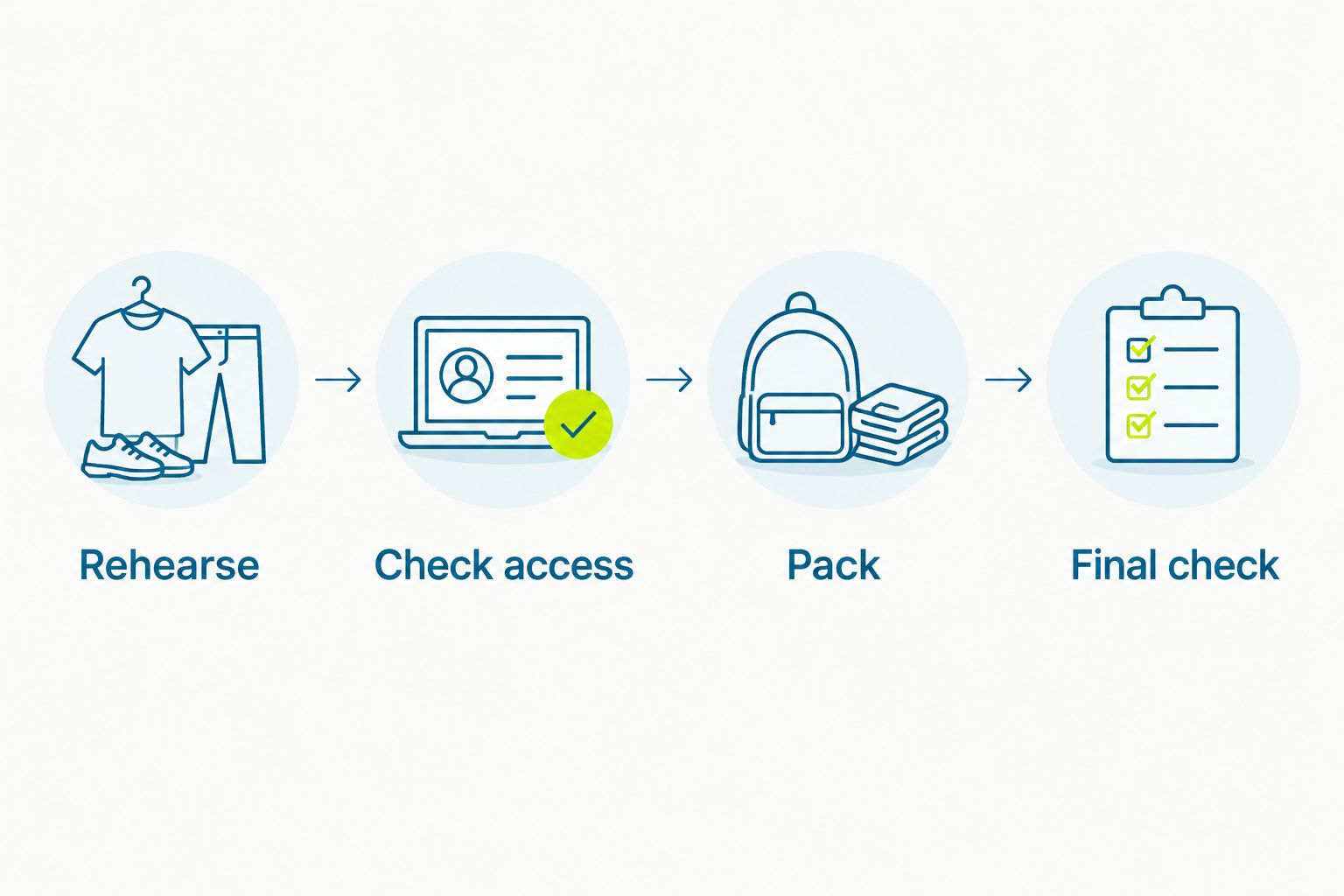
For a 2026 reveal, make the practical checks before setting up photos. Inspect the background, clear walking routes, and confirm the costume still sits correctly after travel; then move to poses and camera framing.
SECOND WORKFLOW: WHEN YOUR WIG OR ACCESSORIES CHANGE
Changing a wig, headpiece, belt, or shoes changes the outfit’s setup even when the main costume stays the same. Repeat the affected checks instead of restarting every task.
- Mark the changed component. Return its Fit checked, Rehearsed, and Packed statuses to incomplete in your notes. Leave unrelated, completed garment-care tasks alone.
- Prepare the component separately. For a synthetic hair piece, support the fibers and work through tangles gently from the ends upward. The same principle applies when detangling a synthetic ponytail: avoid dragging an existing knot through the full length.
- Recheck contact points. Look where hair meets collars, earrings meet straps, and belts meet garment closures. Adjust the arrangement without forcing or permanently modifying unfamiliar materials.
- Repeat the relevant movement test. New shoes require walking practice; new headwear requires a visibility check. A different wig also needs a fresh check of how securely and comfortably it sits.
- Update the packing record. Remove the replaced item from the active checklist so the old and new versions do not compete for space or create confusion.
Expected result: the changed outfit passes the checks its new components affect, without unnecessary repeat cleaning or handling.
For synthetic wigs, heat resistance must be explicitly confirmed for that particular item before using hot tools. The word synthetic does not establish a safe styling temperature.
TROUBLESHOOTING: FIX THE ACTUAL FAILURE
THE COSTUME CLOSES BUT PULLS WHEN YOU SIT
Repeat the fitting with your intended underlayers and check the size chart’s measurement type. Do not force the closure or assume a cleaning method will create extra room. Resolve the restriction through appropriate fitting help or a different outfit plan before convention day.
THE PARCEL DOES NOT CONTAIN THE EXPECTED ACCESSORIES
Compare the selected variant with the confirmation and stated components. Record what arrived, retain relevant packaging, and use the seller’s stated contact procedure. Do not assume accessories shown in styled photography were included.
WRINKLES REMAIN, BUT THE CARE LABEL IS UNCLEAR
Stop before applying heat. Seek garment-specific instructions and keep the piece hanging appropriately while you clarify them. Avoid experimenting on a visible area just because you are close to departure.
THE WIG SNAGS ON TRIM OR JEWELRY
Remove the wig before separating the snag gently. Reposition the accessory, check for rough contact points, and repeat the head-turn test. Do not pull the costume and wig apart under tension.
THE PROP DOES NOT MEET EVENT RULES
Follow the convention’s current policy and leave noncompliant props out of the outfit. Keep an alternative pose or accessory plan that does not depend on the rejected item. Costume accuracy does not override venue requirements.
CUSTOMIZE YOUR WORKFLOW
Keep a reusable core checklist, then add only what the next character needs. For coordinated appearances, track shared props and individual dressing requirements separately; the group cosplay costume ideas guide gives that planning its own space.
With Rosemchale costume orders, keep the selected variant and its care information attached to your outfit record. That is more actionable than a folder full of product screenshots without a clear record of what you chose.
FAQ
How do I prepare a cosplay costume before a convention?
Confirm the selected components, inspect the costume, check fit with your underlayers and shoes, follow each care label, rehearse, and pack by outfit. Finish with a check of closures, badge access, visibility, and event rules.
Should I wash a new cosplay costume before wearing it?
Follow the finished garment’s care label rather than automatically machine-washing it. If instructions are absent or unclear, seek garment-specific guidance before cleaning.
Can I steam wrinkles out of a cosplay costume?
Use steam only when the garment’s instructions permit it. Prints, coatings, trim, and mixed materials need consideration even when the base fabric appears familiar.
How do I know whether my cosplay costume fits?
Check fit while wearing the complete outfit, including intended underlayers and footwear. The costume should close without force and allow the movements you need, including sitting and walking.
What should I do if my costume set is missing a piece?
Compare the parcel with your order confirmation and selected variant’s stated components. Photograph the contents, retain relevant packaging, and follow the seller’s stated contact procedure.
Can I use hot tools on a synthetic cosplay wig?
Use hot tools only when heat suitability and instructions are explicitly confirmed for that wig. Synthetic fibers do not share one universal safe styling temperature.
What belongs in a convention costume repair kit?
Pack repair materials appropriate to your costume, such as matching thread, a needle, spare fasteners, and permitted scissors. Store sharp items securely and check event and travel restrictions before packing.
ONE LAST THING
Practice the bathroom break before practicing the reveal pose. If you cannot remove the necessary layers and put them back on without damaging the costume, the outfit is not ready—however good the photos look.