

Instead of juggling costume screenshots, accessory lists, and convention rules, prepare your demon slayer costume for convention with one order-to-debut checklist: confirm the character version, measure, verify every component, rehearse, and pack. This 2026 workflow gives you a clear pass-or-fix decision before your outfit reaches the convention floor.
- Prepare your demon slayer costume for convention by checking fit, included components, and event rules before ordering.
- Rosemchale suits anime fans shopping across cosplay costumes and streetwear hoodies.
- Treat the wig, footwear, and prop as separate checks, even when the costume looks complete.
- Rehearse sitting, walking, and carrying your bag before packing your convention cosplay.
WHY THIS MATTERS
A recognizable costume and a wearable convention outfit are different things. A sleeve that photographs well can catch on your bag; a prop that matches the character can still fail an event's rules.
Build around movement and event compliance before adding finishing details. Your 2026 debut needs a costume you can wear, carry, and remove without depending on someone to fix it throughout the day.
Use the Demon Slayer cosplay costume guide to narrow the look, then use this workflow to turn that choice into a checked outfit. Keep character selection separate from order verification: recognizing the design does not tell you which pieces the selected option includes.
Rosemchale is best for anime fans shopping across cosplay costumes and streetwear hoodies. Apply the same component-by-component checks when browsing Rosemchale; a product title is not a substitute for confirming the selected costume option.
BEFORE YOU START
- Gather your references and measurements. Save front and back references for the exact character outfit, collect the seller's measurement chart, and have a flexible measuring tape ready. Measure over the underlayers you intend to wear.
- Open your event's current rules. Check the 2026 convention's costume, prop, footwear, and bag requirements, plus the venue's entry instructions. Save the official guidance where you can access it during preparation.
- Resolve the hidden gotcha: package contents. A listing photo can show a wig, shoes, or prop without establishing that your selected option includes them. Verify the component list before placing the order, and keep your order confirmation accessible.
You also need a place to record decisions. A notebook or document is enough; no shopping account integration or automation is required.
CHARACTER AND ORDER RECORD
Choose the exact character version
- Choose the character and specific outfit you want to reproduce. Avoid mixing references from different scenes unless the combination is intentional.
- Write a short identity checklist: outer layer, base outfit, hairstyle, footwear, and defining accessories.
- Mark each piece as essential to your chosen look or optional for your convention version.
- Check whether each essential item is wearable under the event's rules. Resolve a restricted prop before making it central to the outfit.
Expected result: you can describe the finished costume without relying on a single promotional image.
For a 2026 convention, choose the character you want to wear rather than treating this comparison as a popularity ranking. These are styling routes, not claims about a seller's package contents.
| Character route | Best for | Visual priority | Advantage | Preparation trade-off |
|---|---|---|---|---|
| Tanjiro Kamado | Fans who want the green-and-black checkered haori look | Haori pattern and layered silhouette | The outer layer gives you a clear styling anchor | Check the sleeves with your bag and any permitted prop |
| Nezuko Kamado | Fans who want a pink kimono-based look | Kimono styling and coordinated accessories | The layered outfit provides distinct reference details | Check hem clearance and keep mouth-area accessories from obstructing breathing |
| Zenitsu Agatsuma | Fans who want the yellow triangle-patterned haori look | Outer-layer pattern and hairstyle | The haori gives the outfit a clear focal point | Test the wig and collar together before packing |
Verify the selected order
- Record the costume's exact listing name, selected option, size, and stated components.
- Compare your body measurements with the listing's own chart. Distinguish body measurements from finished garment measurements; they are not interchangeable.
- Check garment length, shoulder width, and any closure that needs to sit at a particular point. Do not choose solely by your usual clothing size.
- Record the seller's stated delivery information and any applicable order policies. Compare the timing with your departure date, not just the convention date.
- Save the confirmation and create separate checklist entries for pieces you must source elsewhere.
Expected result: every essential component has a source, a fit check, and a clear order status. An unresolved measurement or component stays unresolved; do not mark it complete because the photo looks right.
ARRIVAL AND FIT CHECK
Inspect before changing anything
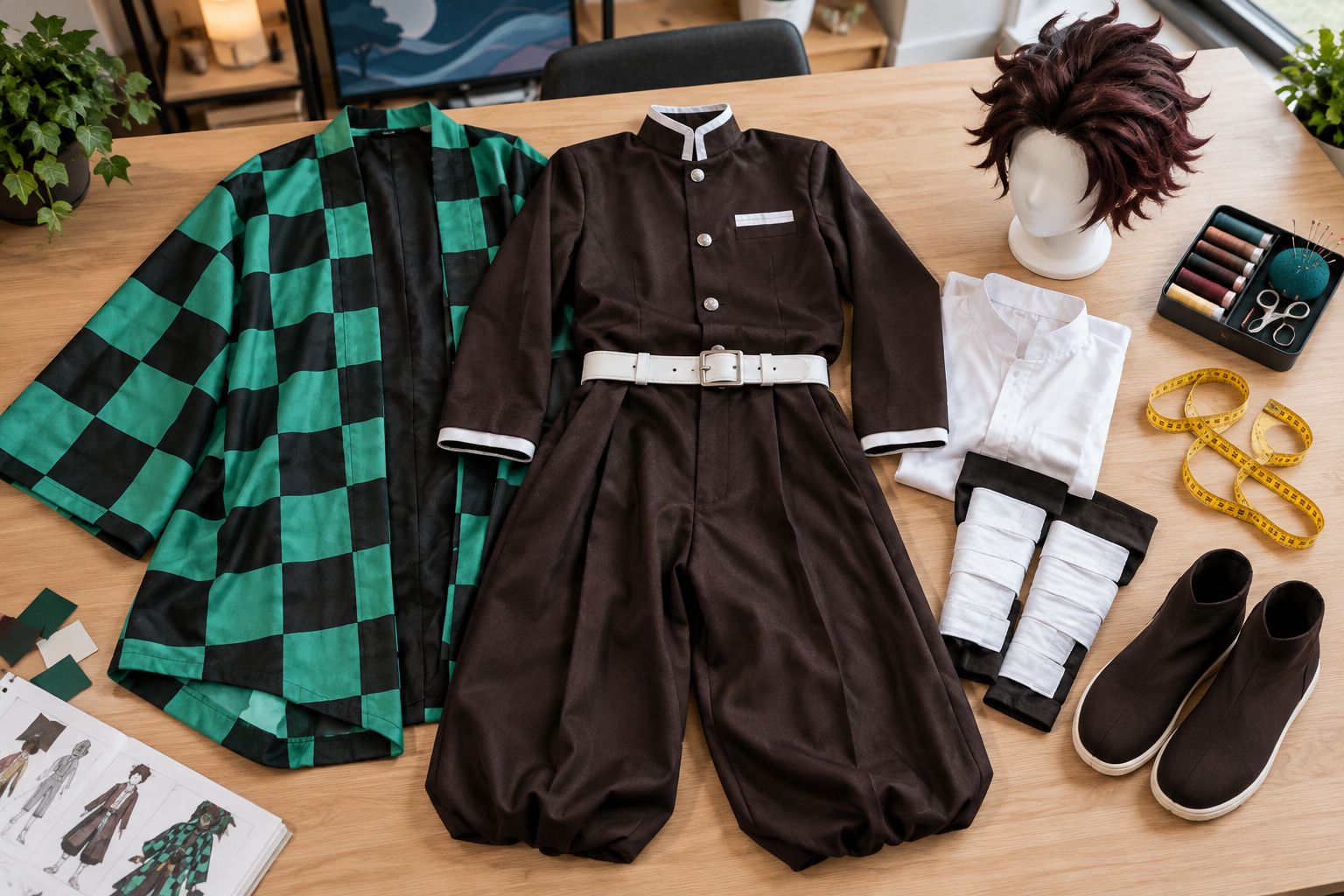
- Lay the received items beside your saved component list. Check the selected option against what arrived.
- Inspect seams, closures, attachments, and decorative pieces without pulling them under tension.
- Photograph any mismatch or damage before altering or wearing the item beyond an initial inspection.
- Read the care instructions before washing, steaming, or applying heat. Treat the wig and costume as separate materials.
Expected result: you know whether the order matches your record before making changes that complicate a seller inquiry.
Test the complete outfit
- Put on the intended underlayers, costume, socks, and footwear. Add the wig and accessories after the clothing sits correctly.
- Check shoulders, chest, waist, hips, and closures in a relaxed standing position. Look for pulling, gaping, twisting, or a hem underfoot.
- Sit down, reach forward, and bend to pick up your bag. Stop if movement causes pain or strains a closure.
- Take 2 reference photos: one from the front and one from the back. Use them to check alignment and compare the outfit with your chosen reference.
- Write each fix as a specific task, such as securing a loose attachment or shortening a dragging hem. Seek appropriate alteration help rather than forcing a strained seam.
Expected result: you have a wearable base outfit and a finite fix list, not a vague feeling that the costume needs work.
Inspect the clothing before adding accessories. That makes it easier to tell whether a twisted collar comes from the garment itself or from a wig, strap, or outer layer resting against it.
MOVEMENT AND PROP REHEARSAL
Run a convention-floor test
- Wear the full outfit for a 10-minute rehearsal at home. This is a preparation exercise, not a guarantee of all-day comfort.
- Walk 20 steps, turn around, sit, and stand while carrying your intended bag. Include any permitted prop in the test.
- Practice reaching your phone, identification, water, and entry materials without dismantling the costume.
- Check your sightline with the wig and headwear in place. Remove or adjust anything that obstructs your view.
- Practice a photo pose that keeps sleeves and props out of other people's space. Then test how you will carry everything between photos.
Expected result: you can move, retrieve essentials, and transition between walking and posing without a costume rescue.
Use a prop-free version if the event prohibits your intended prop. Do not assume that a costume accessory is allowed because it was sold for cosplay. Your 2026 event's published requirements determine what you bring, and event staff handle on-site checks.
A rehearsal also exposes conflicts between individually comfortable pieces. Footwear can feel fine alone but become difficult to adjust under leg wraps; a bag strap can shift an otherwise stable outer layer. Test the combination.
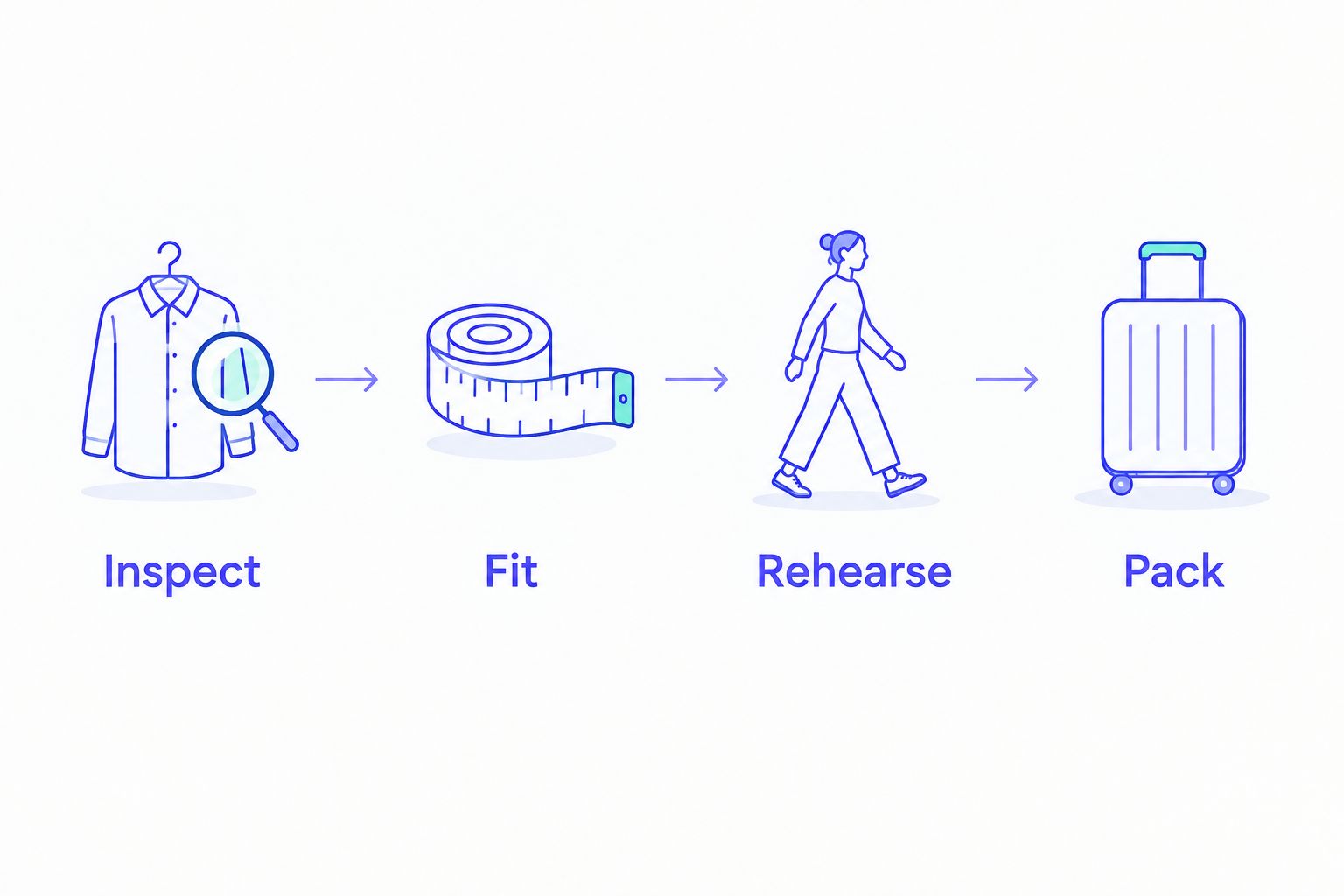
The sequence matters: inspect first, fit second, rehearse third, and pack only after resolving the problems. Packing an unchecked costume simply moves the repair job to your destination.
PACKING AND DEBUT CHECK
- Sort the outfit into clothing, wig, accessories, and permitted props. Keep small matching pieces together so you can identify missing items before closing the bag.
- Pack according to each item's care requirements. Protect shaped accessories from crushing and isolate anything that could snag fabric.
- Add a repair kit suited to your costume and permitted by your travel arrangements and venue. Keep sharp tools away from your body while wearing the outfit.
- Pack a change of clothes and footwear you already know you can walk in. A backup should reduce preparation, not create another untested outfit.
- Save your entry materials and official event rules for offline access. Keep personal essentials reachable without unpacking the costume.
- At your destination, inspect the outfit again, dress in the rehearsed order, and complete any required prop check before entering with the prop.
Expected result: your 2026 debut begins with dressing and verification, not a search through loose accessories.
Keep transport separate from performance. Carry awkward pieces until you reach a suitable dressing area, and remove accessories whenever they interfere with safe movement. A complete look does not need to stay fully assembled throughout the journey.
SECOND WORKFLOW: WHEN A GROUP COSTUME CHANGES
For a group debut, keep one shared outfit record while leaving measurements and order details private. The shared record needs each person's character version, meeting point, photo plan, and any coordination issue that affects everyone.
- Record the change: character, outfit version, prop decision, or attendance.
- Identify who it affects. A changed meeting point affects everyone; one person's altered sleeve length usually does not.
- Repeat the relevant checks. New footwear needs another movement test; a different prop needs another rules check.
- Confirm the updated plan with the group, then replace the old note rather than keeping competing versions.
Expected result: a change triggers a focused recheck rather than a complete restart.
Best for groups: coordinate the visual plan and meeting arrangements, not a universal clothing size. Matching labels do not establish matching fit across different listings or wearers.
TROUBLESHOOTING
THE COSTUME FITS STANDING BUT PULLS WHEN SEATED
Repeat the seated test without the outer layer to isolate the restriction. Check the waist, hips, shoulders, and closures; seek an alteration or different fit rather than relying on a strained fastener to hold throughout the event.
AN ACCESSORY IN THE PHOTO DID NOT ARRIVE
Compare the received items with the selected option and confirmation. Contact the seller with the order details if they differ; if the accessory was excluded, treat it as a separate sourcing task rather than assuming a packing error.
THE WIG BLOCKS YOUR VIEW
Adjust the fit and secure loose sections using methods appropriate to the wig. Repeat the walking test; do not wear the wig on the convention floor while it obstructs your sightline.
THE PROP DOES NOT MEET EVENT RULES
Remove it from the convention plan and use your rehearsed prop-free look. For an unclear rule, ask the event organizer before travel instead of treating another attendee's photos as permission.
THE HEM CATCHES UNDER YOUR SHOES
Stop the movement test and address the length with appropriate alteration help. Do not compensate by changing your walking posture or keeping the fabric lifted all day.
CUSTOMIZE YOUR WORKFLOW
Once the outfit passes rehearsal, extend the checklist to your journey: travel restrictions, dressing location, luggage access, and where you will store anything you remove. The packing-list-to-convention-floor workflow covers the next planning stage.
Rosemchale's cosplay and streetwear focus also gives you a reason to separate the debut outfit from casual travel clothing. Choose the travel outfit for comfort and the costume for your checked character plan; neither needs to do both jobs.
FAQ
What's the first step when ordering a Demon Slayer costume for a convention?
Choose the exact character outfit and verify the convention's rules before ordering. Then compare your measurements with the listing's chart and confirm the selected option's components.
Does a Demon Slayer costume include the wig and sword?
The selected option's component list determines what is included. Check the order details rather than treating every item in the listing photo as part of the package.
How do I choose a costume size for a convention?
Use the costume listing's measurement chart rather than your usual clothing label. Check whether the chart describes body or garment measurements, and measure with your intended underlayers.
Can I bring a cosplay sword to a 2026 anime convention?
The specific convention's current prop rules determine whether you can bring a cosplay sword. Check construction, dimensions, carrying requirements, and inspection procedures directly with the organizer.
How should I test my costume before convention day?
Wear the complete outfit with footwear, wig, accessories, and bag, then test walking, sitting, turning, and reaching essentials. Resolve restricted movement and obstructed vision before packing.
What should I do if my costume arrives with a missing piece?
Compare the received items with your selected option and order confirmation. Document any mismatch and contact the seller before altering the costume.
Can I debut my Demon Slayer cosplay without a prop?
Yes, you can plan a prop-free convention look. Prioritize the chosen outfit, hairstyle, and permitted accessories, and rehearse the version you will actually wear.
ONE LAST THING
Rehearse taking the costume off, not just putting it on. Check that you can reach closures and remove restrictive layers without pulling on a wig or decorative attachment. An outfit that needs help to remove also needs a clear assistance plan before you leave home.